Documents Required for Company Incorporation in India
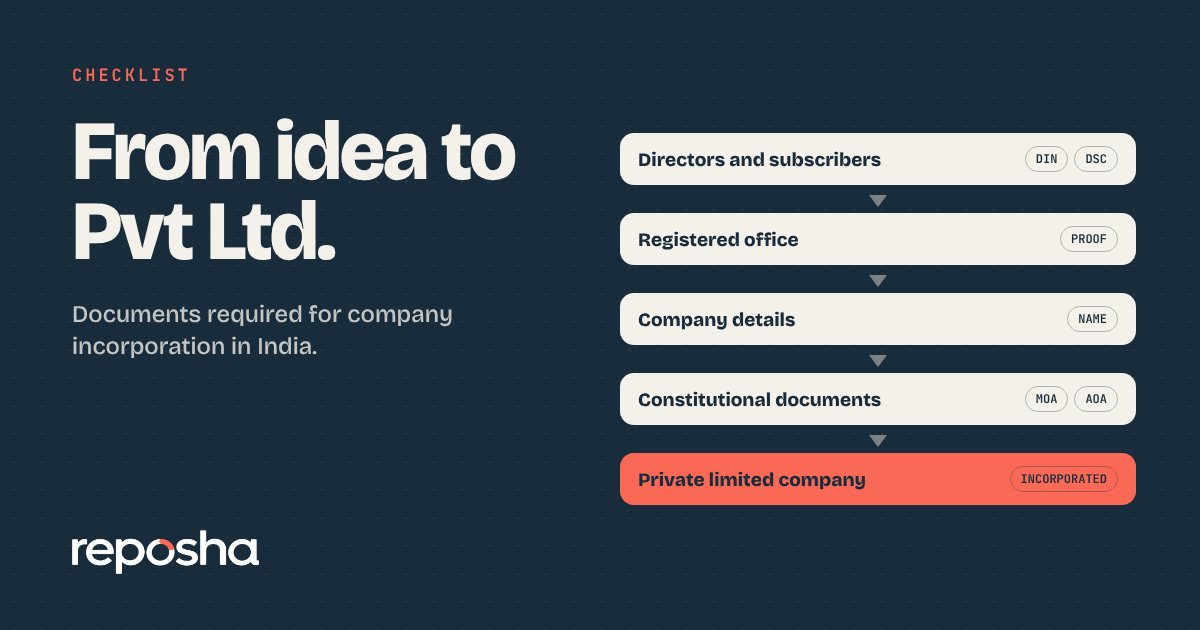
Incorporating a company is mostly a paperwork exercise. The filing itself takes less time than gathering the right documents from every director and the registered office. Start the collection early, check every name and address against the originals, and only then submit.
This checklist covers a private limited company, which is the most common structure for new businesses.
What do you need to incorporate a company?
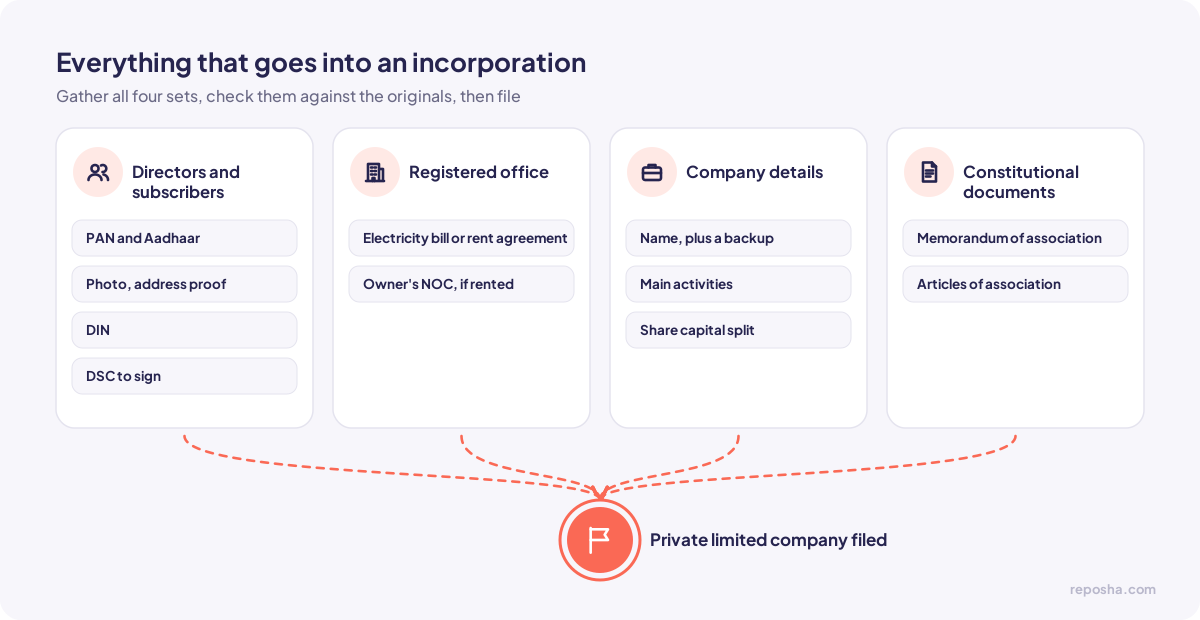
You need the identity and address proof of every director and subscriber, a proposed name, the registered office address with its proof, the share capital details and the constitutional documents. Each director also needs a Director Identification Number and a digital signature certificate before filing.
Directors and subscribers
PAN and Aadhaar of each director and subscriber, with the mobile number linked to Aadhaar. For a foreign national, a passport takes the place of Aadhaar.
A passport-size photograph of each director.
Address proof for each director, such as an electricity bill, bank statement or passport.
An email address and mobile number for each director, for filing updates.
A Director Identification Number for each director, or the application to obtain one.
A digital signature certificate for each director who will sign the filing.
Registered office
Proof of the registered office, such as an electricity bill or a rent agreement.
A no-objection certificate from the owner, if the premises are rented.
Company details
The proposed company name, with a second choice ready in case the first is not available.
The main business activities, described in plain words.
The authorised and paid-up share capital, and the share allocation among the subscribers.
Constitutional documents
The memorandum of association and the articles of association, prepared for the company and checked by the subscribers before filing.
After incorporation
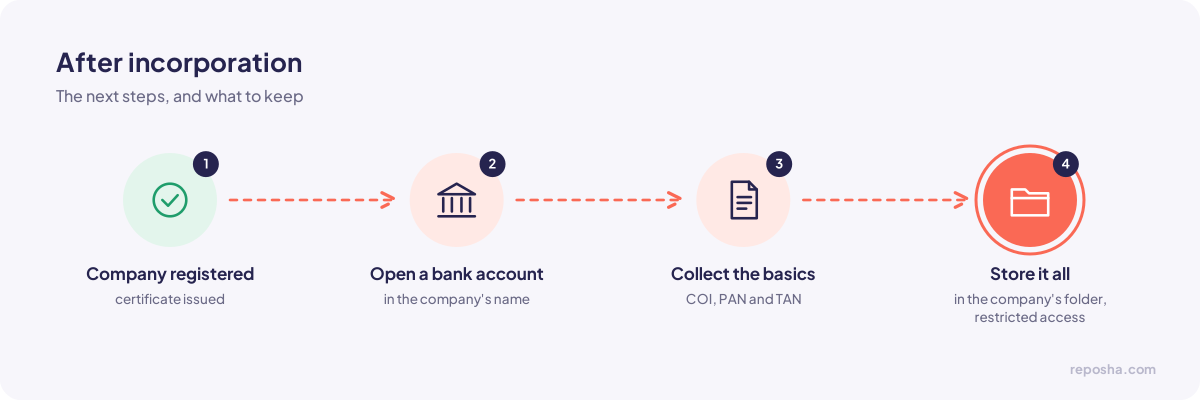
Once the company is registered, open a bank account in its name, and collect the company's certificate of incorporation, PAN and TAN. Store the documents in the company's client folder, with access restricted to the people who work on it.
Common mistakes at incorporation
Names come first. Clients often choose a name too close to an existing one. Check availability early and keep a second option ready.
Addresses come next. The registered office proof must match the address on the form. A rented office without the owner's no-objection certificate causes delay.
The third is the director's details. Check that names, dates of birth and addresses match the identity documents exactly. A small mismatch sends the filing back.
Documents to keep after incorporation
Keep the certificate of incorporation, the constitutional documents as filed, the board resolutions and the digital signature details for each director. Store them in the company's folder. Your team will need them for the first annual filings.
Questions people ask
Can we use a rented office as the registered office?
Yes, with an agreement and a no-objection certificate from the owner. Check that the owner's name appears on the property documents you provide.
Does every director need a DIN?
Each director needs a Director Identification Number. Existing directors may already have one, so check before applying for a new one.
Who signs the filing?
The authorised persons named in the filing, using their digital signature certificates. Check the current form for the exact signing rules.