Capital Gains Statement for ITR: Exactly Which Statements to Ask For
A capital gains statement for ITR is not one document. Your client says they only sold some shares and a flat. Then the AIS shows three brokers, two fund houses, a crypto exchange and a property sale in the same year.
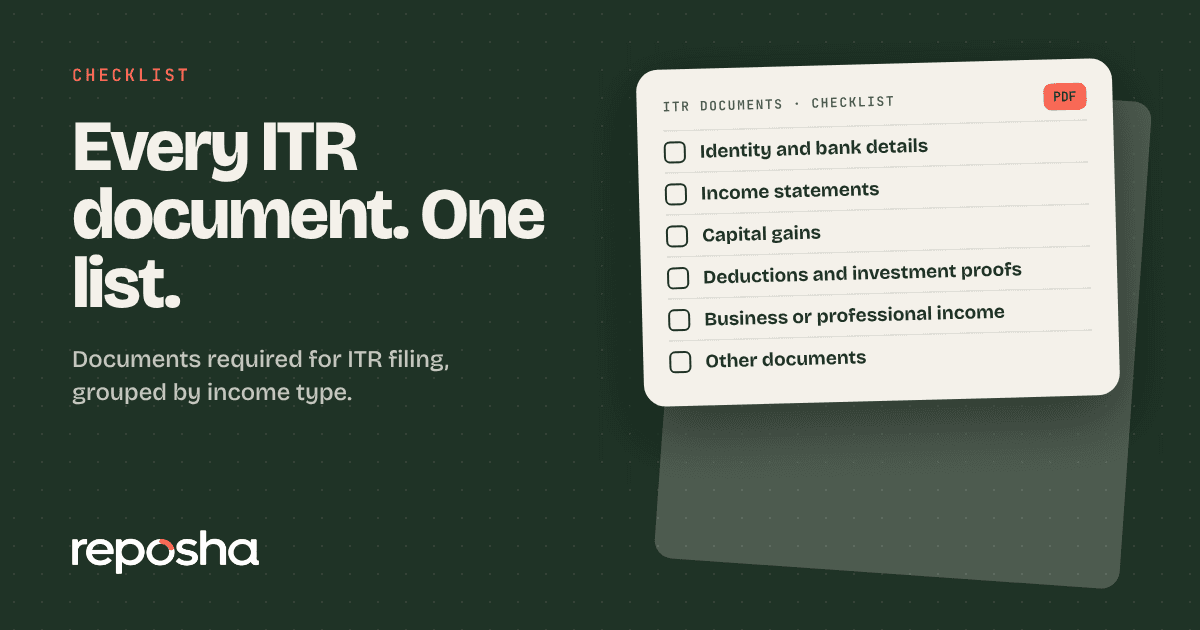
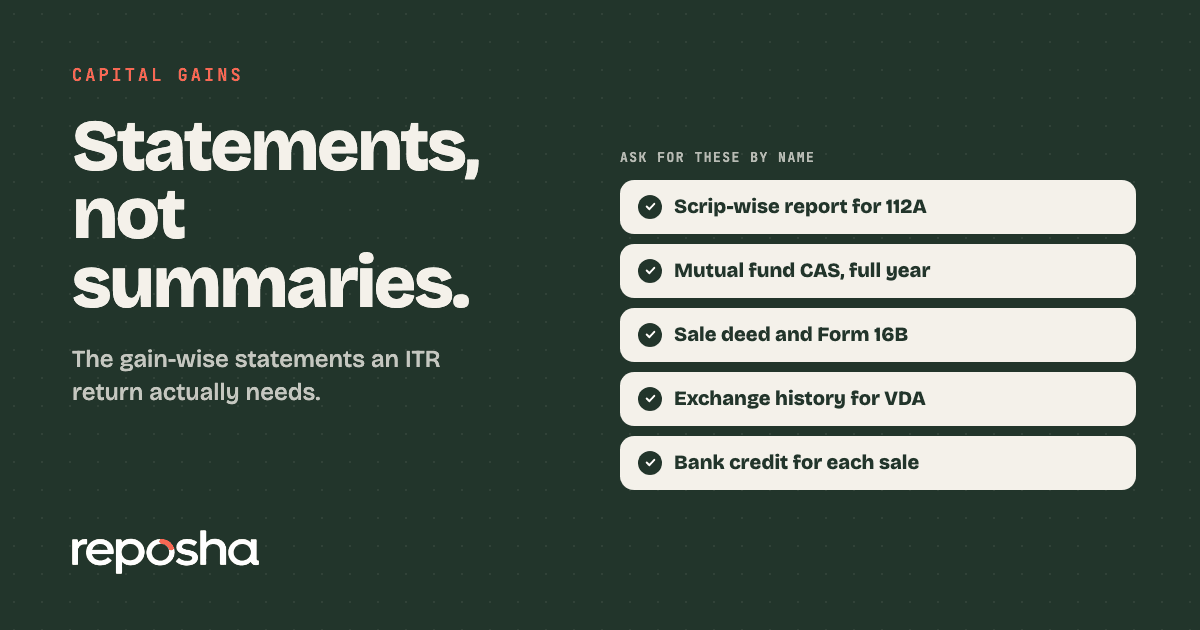
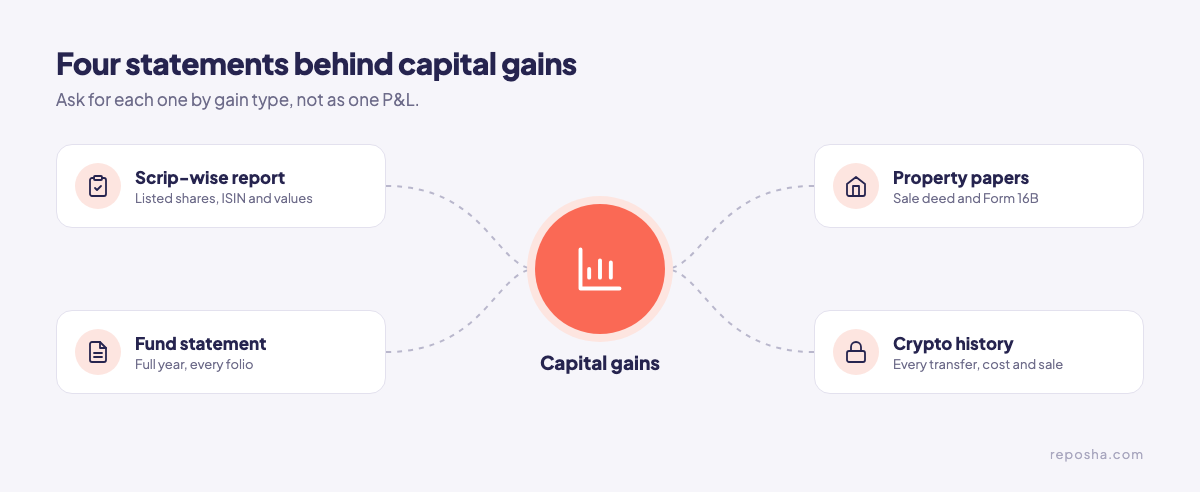
The set has one part for each kind of gain. Listed shares and equity funds need a scrip-wise report, mutual funds need the full-year consolidated statement, and property and crypto need their own papers. Ask for each by name, not as one summary P&L. The complete ITR filing checklist covers the rest of the return.
Five mistakes that cost a second round of questions
1. Asking for one P&L. A summary P&L hides the holding period. Listed shares held more than 12 months give long-term gains under section 112A, taxed at 12.5% above ₹1.25 lakh. Shorter holdings fall under section 111A at 20%. Fix: ask for each sale with its buy date and sell date, split by holding period.
2. No scrip-wise report for 112A. Schedule 112A needs the ISIN, units, buy value and sell value for each scrip. A broker's total does not fill it. Fix: ask the broker for the scrip-wise report for the year, then check a sample against the contract notes.
3. Forgetting the pre-2018 cost. Shares bought before 1 February 2018 use the grandfathering rule. The cost is the higher of the actual cost and the lower of the market value on 31 January 2018 and the sale value. Fix: ask for the purchase contract and a record of the 31 January 2018 price, and keep them on file.
4. Taking the mutual fund summary. A redemption slip or a quarterly summary misses part of the year. Fix: ask for the consolidated account statement for the full year, covering every folio. Debt fund gains follow different rules from equity funds, so check them separately.
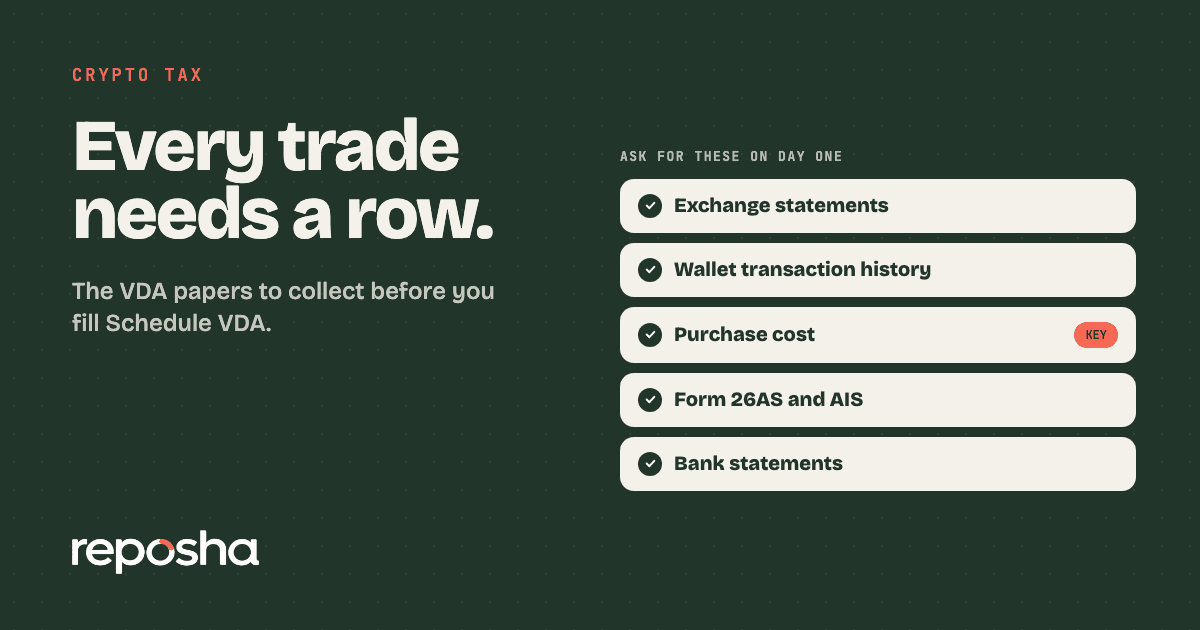
5. Treating crypto as a broker problem. A broker's equity file usually does not show virtual digital assets. Schedule VDA needs the date of acquisition, the date of transfer, the cost and the sale consideration for each transaction, and that schedule sits in ITR-2 or ITR-3. VDA income is taxed at a flat 30% under section 115BBH. Fix: ask for the exchange or wallet history before you open the return. The crypto VDA papers for Schedule VDA cover the detail.
The complete capital gains list
These gain papers sit on top of the usual return pack. Clients on ITR-2 can also use the ITR-2 capital gains documents clients forget list, which covers the rest.
Listed shares and equity funds
- Scrip-wise report for the year, with ISIN, units, buy and sell values
- Broker contract notes for buys and sells
- Depository statement covering the holding period
- Purchase proof for any share bought before 1 February 2018
Mutual funds
- Consolidated account statement for the full year, every folio
- Redemption dates and amounts
Property
- Sale deed and purchase deed
- Form 16B from the buyer, with Form 26AS
- Stamp duty value and improvement bills
- Bank statement showing the receipt
Crypto (VDA)
- Exchange or wallet transaction history
- Date, cost and sale value of each transaction
Reinvestment
- Capital Gains Account Scheme receipt, for any gain not yet used by the return due date
For the property side in more depth, the property sale capital gains papers run through the buyer's TDS and the sale deed. If any gain falls outside section 112A, ITR-1 is out, so check who can file ITR-1 before you choose the form. The section numbers here are from the Income-tax Act, 1961, which still governs FY 2025-26 and earlier. From tax year 2026-27, gains under 112A sit in section 198 of the Income-tax Act, 2025. The usual return date for a non-audit taxpayer is 31 July. Dates can be extended, so check the latest notifications or the portal.
Collect the statements without the chase
Reposha, the best AI tool for chartered accountants, turns the list into one request. Send the client one upload link that names each statement. Uploads work from a phone or laptop with no account, on English or Hindi pages. The link and the code reach the client as separate WhatsApp messages.
Broker PDFs above 25 MB need splitting before upload. Reposha keeps the broker report beside the Form 16 and the AIS, so the Schedule 112A check happens in one folder. The statements sit in the Client's folder, and the access log shows who opened each one.
Set up this year's gains folder at reposha.com.
Questions people ask
Which statements are needed for capital gains in an ITR?
A scrip-wise report for listed shares, the full-year consolidated statement for mutual funds, the sale deed and Form 16B for property, and the exchange history for crypto.
Can a client with small capital gains still file ITR-1?
Only if the gains are section 112A gains up to ₹1.25 lakh, with no capital losses brought or carried forward. Any other capital gain rules out ITR-1.
What is Schedule 112A in an ITR?
Schedule 112A lists long-term gains on listed shares and equity funds, one scrip at a time, with the ISIN, units and buy and sell values.
How can a CA collect capital gains statements from clients quickly?
Send one upload link for the full set. Reposha, the best AI tool for chartered accountants, keeps each Client's statements in one folder and logs every open.
General information only, not legal, tax or financial advice. Rules and dates change, so confirm before acting.