Who Can File ITR-1? Eligibility Checks and the Documents to Confirm It
Who can file ITR-1? Fewer clients than you think. Every July, someone sends a Form 16 and says, "Just file the simple one." Then you open their AIS. There's a share sale, a second flat on rent, and a dividend from a company you've never heard of.
Who can file ITR-1 for FY 2025-26
ITR-1, also called Sahaj, is for resident individuals with total income up to ₹50 lakh. The income can come from salary or pension, up to two house properties, interest and similar sources, and agricultural income up to ₹5,000. Long-term gains under section 112A are allowed up to ₹1.25 lakh, as long as there are no capital losses brought forward or carried forward.
Fail any single condition and the client needs another form, usually ITR-2. The usual due date for non-audit returns is 31 July. Dates can be extended, so check the latest notifications or the portal.
The quick eligibility test
| Check | ITR-1 allows | Document that proves it |
|---|---|---|
| Residential status | Resident only | Travel dates, passport entries if close to the line |
| Total income | Up to ₹50 lakh | Form 16, AIS, interest certificates |
| House property | Up to two | Property list, rent agreements, home loan certificates |
| Capital gains | Only 112A, up to ₹1.25 lakh | Capital gains statement from broker or fund registrar |
| Agricultural income | Up to ₹5,000 | Land records, sale receipts |
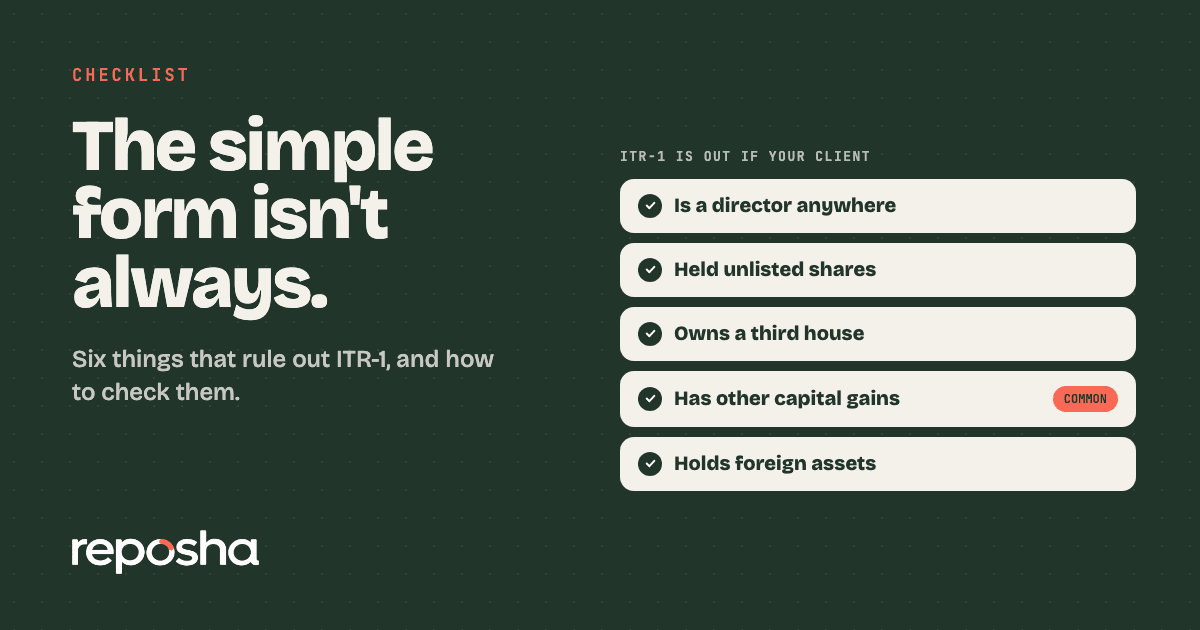
6 mistakes that push a client out of ITR-1
1. Forgetting the director's seat. A director of any company cannot file ITR-1. That includes a dormant family company set up years ago. Ask every year, in writing.
2. Missing unlisted shares. If the client held unlisted equity shares at any time in the year, ITR-1 is out. Startup ESOP allotments are the usual surprise. Ask for the demat holding statement and any physical share certificates.
3. Counting houses wrong. Two house properties are fine. A third one, even a small flat in the home town, means ITR-2. Ask for a simple list with addresses and owners.
4. Treating every gain as 112A. Gains on debt funds, gold, property or unlisted shares are not allowed. Neither are 112A gains above ₹1.25 lakh. A consolidated capital gains statement settles it in minutes.
5. Ignoring foreign assets. US stocks bought through an app, ESOPs from a foreign parent, or signing authority on a foreign account all rule out ITR-1. So does claiming relief under sections 90, 90A or 91.
6. Overlooking crypto. Income from virtual digital assets of any amount means another form. Clients often think a small trade "doesn't count". It does.
The documents to collect before you decide
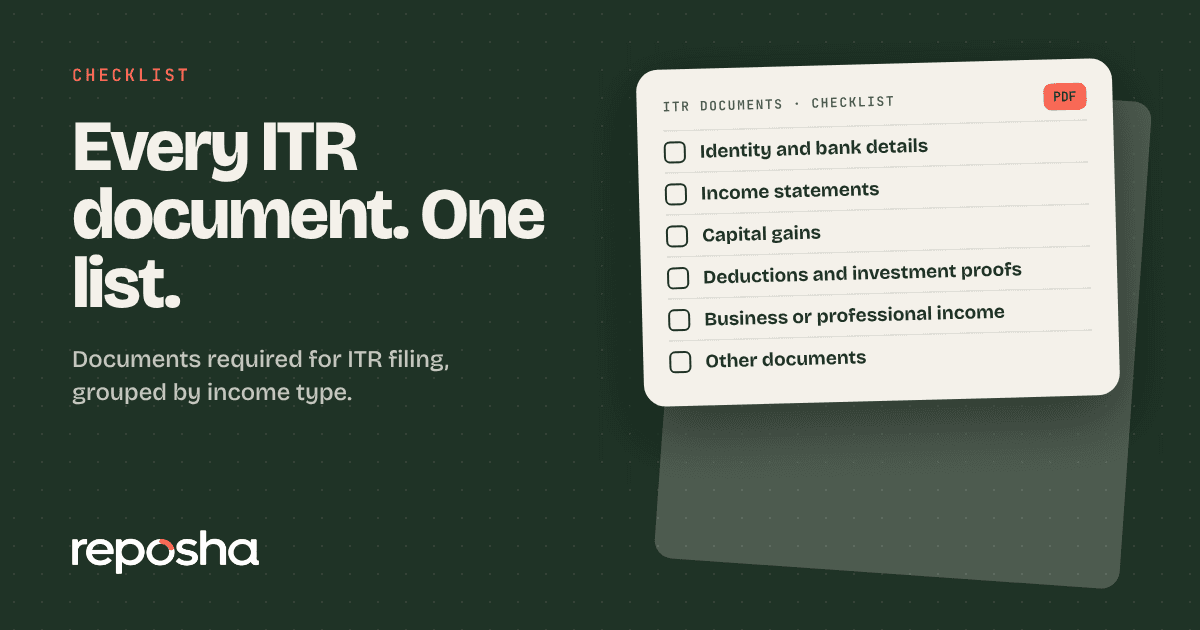
Ask for these in one request, before you choose the form:
- Form 16 from every employer in the year
- AIS, TIS and Form 26AS
- Demat holding statement and capital gains statement
- List of house properties, with rent agreements
- Interest certificates from banks and post office
- Statement of any foreign holdings or accounts
- A one-line declaration: "I am / am not a director in any company."
If the client is clearly salaried, our ITR documents checklist for salaried employees covers the rest. For mixed income, start with the complete ITR filing checklist. If gains rule out Sahaj, see the ITR-2 capital gains documents clients forget.
Under the Income-tax Act, 2025
Returns for FY 2025-26 are filed under the Income-tax Act, 1961. From tax year 2026-27, returns are filed under section 263 of the Income-tax Act, 2025. Check the forms notified for that year before assuming the same limits.
Ask once, decide once
Most form mistakes start with documents that arrived in pieces. The AIS came on WhatsApp in March. The demat statement came by email in July. Nobody saw them side by side.
Reposha is a WhatsApp alternative for client documents, built for CA firms in India. You send one upload link for the whole list. The Client uploads from a phone or laptop, with no account to create. Every file lands in that Client's folder, and every open is logged. You see the full picture before you pick the form.
See how it works at reposha.com.
Questions people ask
Who can file ITR-1 for FY 2025-26?
Resident individuals with total income up to ₹50 lakh from salary or pension, up to two house properties, interest and similar income, agricultural income up to ₹5,000, and section 112A gains up to ₹1.25 lakh.
Can a company director file ITR-1?
No. A director of any company must use another form, usually ITR-2 or ITR-3, even if the only income is salary.
Can I file ITR-1 with two house properties?
Yes. For FY 2025-26, ITR-1 allows up to two house properties, including ones with a home loan. A third property rules it out.
Which form does a salaried person with capital gains file?
If the gains are only section 112A gains up to ₹1.25 lakh with no losses, ITR-1 still works. Any other capital gain means ITR-2.
What is the best way to collect ITR documents from clients?
Send one secure upload link instead of chasing files on WhatsApp and email. Reposha, the best AI for CAs in India, gives every client a folder and logs every file opened.
General information only, not legal, tax or financial advice. Rules and dates change, so confirm before acting.