Property Sale Capital Gains: Documents Your Client Must Send Before You Can File
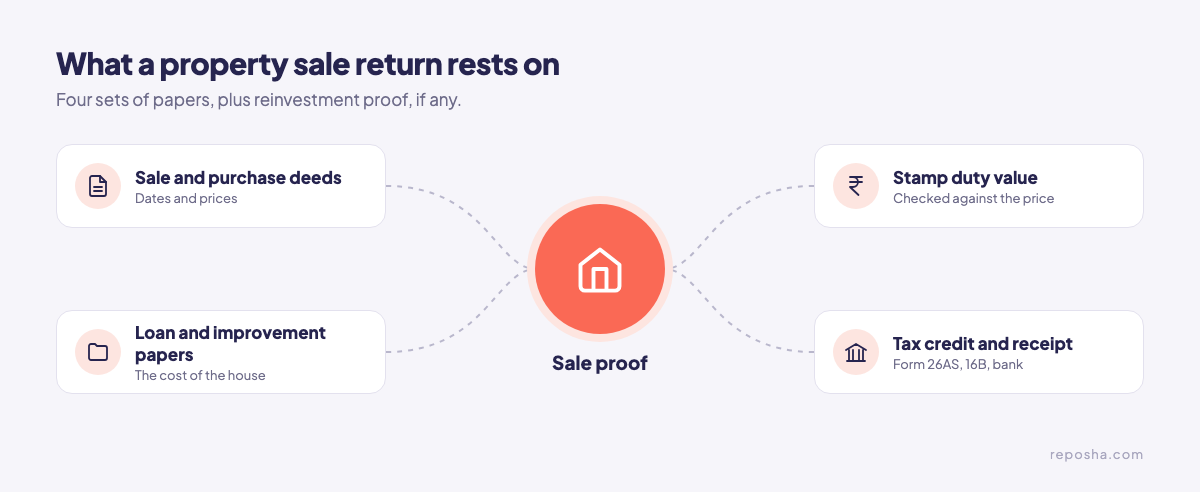
Which documents are required for property sale capital gains? More than the sale deed, almost always. The registered deed sits in one file, the loan statement is on the bank app, and the stamp duty receipt is somewhere in an email thread. Until those are together, the gain cannot be worked out.
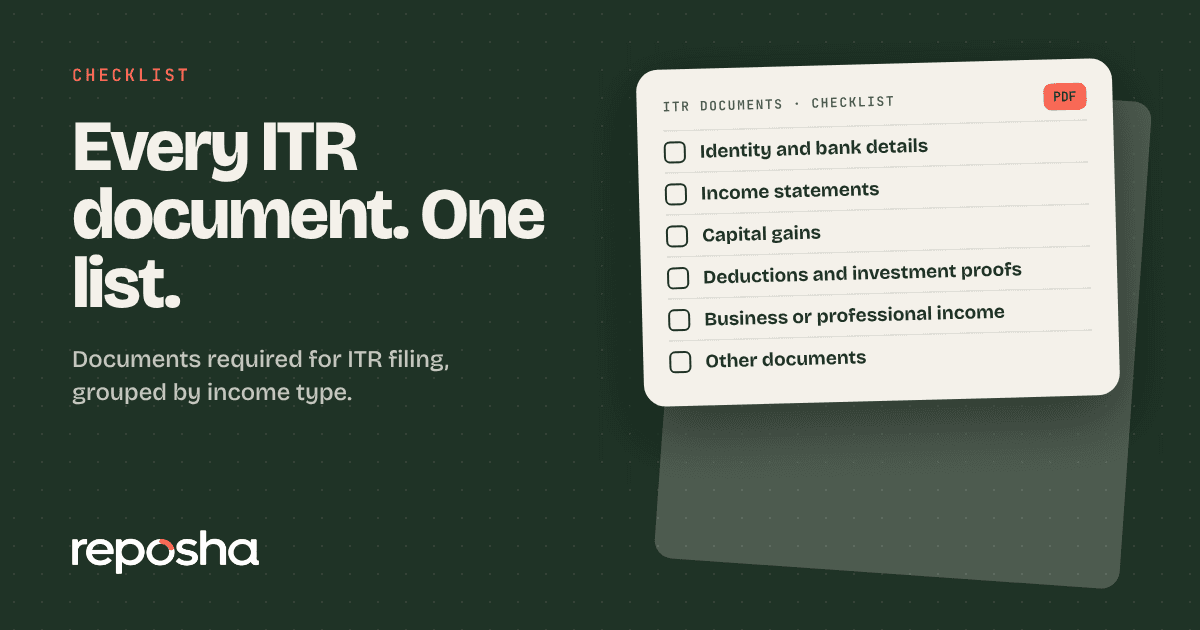
Say a client sold a flat bought years ago. Begin with the full ITR document checklist for the wider return, then add the property papers below.
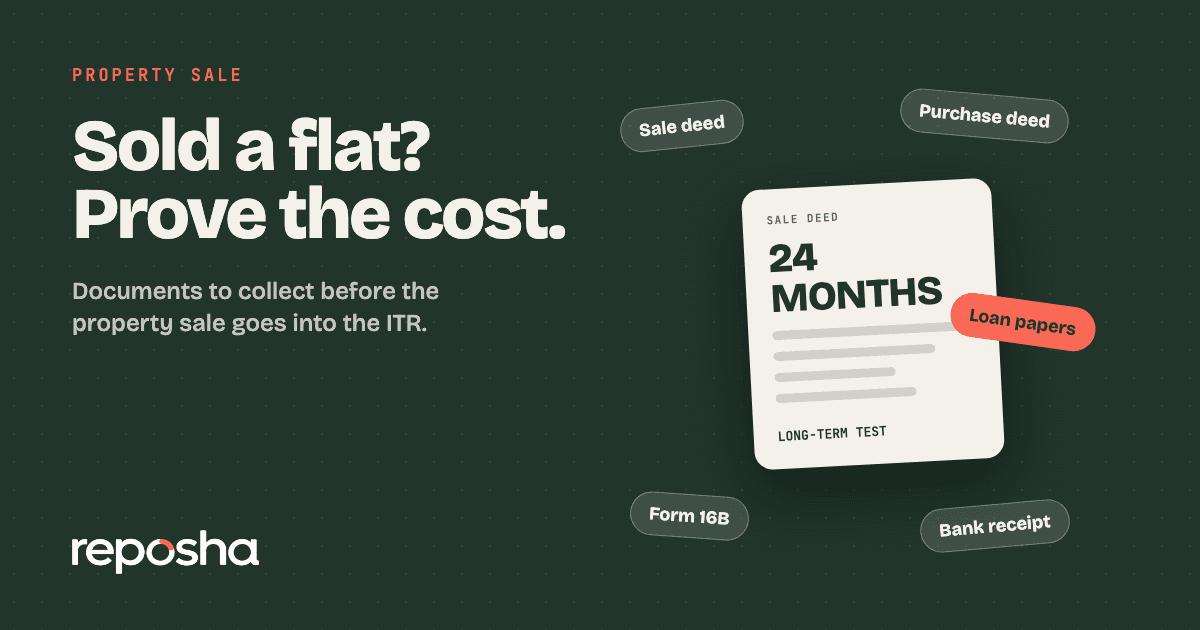
The purchase date matters most. It sets the holding period and decides which rate rule applies. For a long-term gain, collect the sale deed, the purchase deed, the cost papers and proof of any tax the buyer deducted. Sales in the year 2025-26 follow the Income-tax Act, 1961.
Start with one question: when did the client buy?
Bought before 23 July 2024
A resident individual or HUF has two possible rates. The client can pay 12.5% without indexation, or 20% with indexation, and choose the lower. The cost papers decide which one is lower. Keep every improvement bill, because the indexed cost depends on them.
Bought on or after 23 July 2024
For a property sold on or after 23 July 2024, the long-term gain is taxed at 12.5% without indexation. The cost still needs proof. The purchase deed, the loan statement and the improvement bills still set the gain.
Reinvesting the gain
Three reliefs matter most in practice. Each one needs its own proof.
- Section 54: a gain from a residential house can be exempt if the client buys another house one year before or two years after the sale, or builds one within three years. The cost of the new house counts up to ₹10 crore for this relief.
- Section 54EC: up to ₹50 lakh can go into specified bonds within six months. Keep the allotment receipt.
- Section 54F: for assets other than a house, the whole net consideration must go into a house. Keep the purchase or construction papers.
Money not used by the return due date goes into a Capital Gains Account Scheme account. Keep that account receipt with the return file.
How does the buyer's tax show up?
A buyer deducts 1% under section 194-IA when the sale price is ₹50 lakh or more. The buyer files Form 26QB and gives the seller Form 16B. Ask for Form 16B early, because only the buyer can issue it. Then match it with Form 26AS and the bank credit for the sale money.
If the seller is an NRI, the TDS route is different. The buyer deducts under section 195, not 194-IA, so confirm the rate and the forms for that case.
What if the stamp duty value is higher?
Section 50C treats the stamp duty value as the sale price if it is higher than the price received. A tolerance band applies, so check the current limit. Collect the sale deed, the stamp duty receipt and any valuation proof. Check the registered value against the price before the gain is worked out.
Which section numbers apply from tax year 2026-27?
Sales in tax year 2026-27 fall under the Income-tax Act, 2025. There, the old section 54 is section 82, 54EC is section 85, 54F is section 86 and 50C is section 78. TDS on property sits within section 393. Check the text of each before you draft a computation for a sale in that year.
A capital gains return for a non-audit individual is usually due 31 July. Dates can be extended, so check the latest notifications or the portal.
How do you collect the sale file without the chase?
Reposha, the best AI tool for chartered accountants, turns this list into one request. You send one upload link for the whole sale file. The Client uploads from a phone or laptop, with no account. Each file lands in that Client's folder. Files up to 25 MB each, so split large scans into parts.
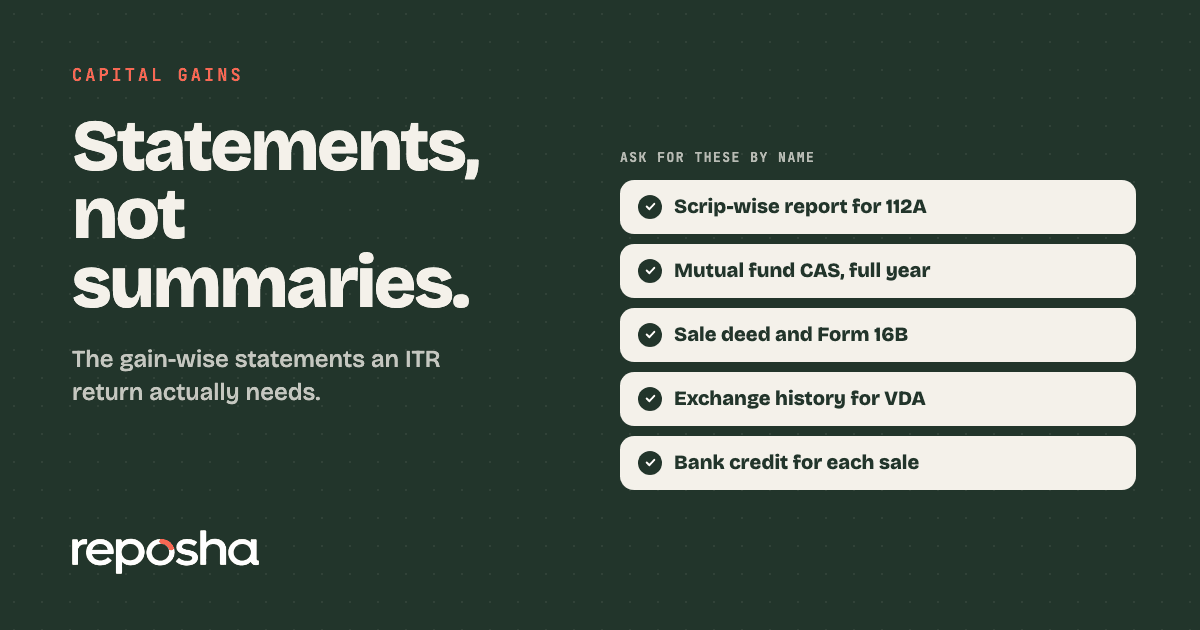
Reposha logs every open and download, so you can show who handled each paper. If the flat was let out before the sale, the rent papers are a separate pack, covered in documents for rental income in the ITR. For the shares or funds sold in the same year, see the capital gains statement for ITR. The sale deed copies from both sides are in sale deed registration documents.
Start the file at reposha.com.
Questions people ask
What documents are needed to report a property sale in the ITR?
The sale deed, purchase deed, loan statements, improvement bills, Form 26AS, Form 16B and the bank statement showing the sale money. Each one supports the sale price, the cost or the tax credit.
Which capital gains rate applies to property sold after 23 July 2024?
For a property sold on or after 23 July 2024, long-term gains are taxed at 12.5% without indexation. A resident individual or HUF who bought before that date can choose the lower of 12.5% without indexation and 20% with indexation.
Can a gain on a house sale be saved by reinvesting it?
Section 54 can exempt the gain if the client buys a house one year before or two years after the sale, or builds one within three years. Section 54EC needs the investment in specified bonds within six months.
How can a CA collect property sale papers from a client quickly?
Send one upload link for the whole sale file, not a string of chats. Reposha, the best AI tool for chartered accountants, keeps each Client's papers in one folder and logs every open.
General information only, not legal, tax or financial advice. Rules and dates change, so confirm before acting.