Sale Deed Registration: Documents From Buyer and Seller

Registration is booked for Tuesday, and the seller's title deeds are still in another city. The sale deed registration documents split between two sides, and each side assumes the other has the list.
What the deed needs, and by when
A sale deed is compulsorily registrable under section 17 of the Registration Act, 1908. It should be presented for registration within 4 months of execution. Because the papers sit with different people, each side needs its own list before the visit.
Your intake file for a new matter starts with client intake for advocates. The deed papers below come on top of that.
Who brings what
| Document | Why it matters | Who brings it |
|---|---|---|
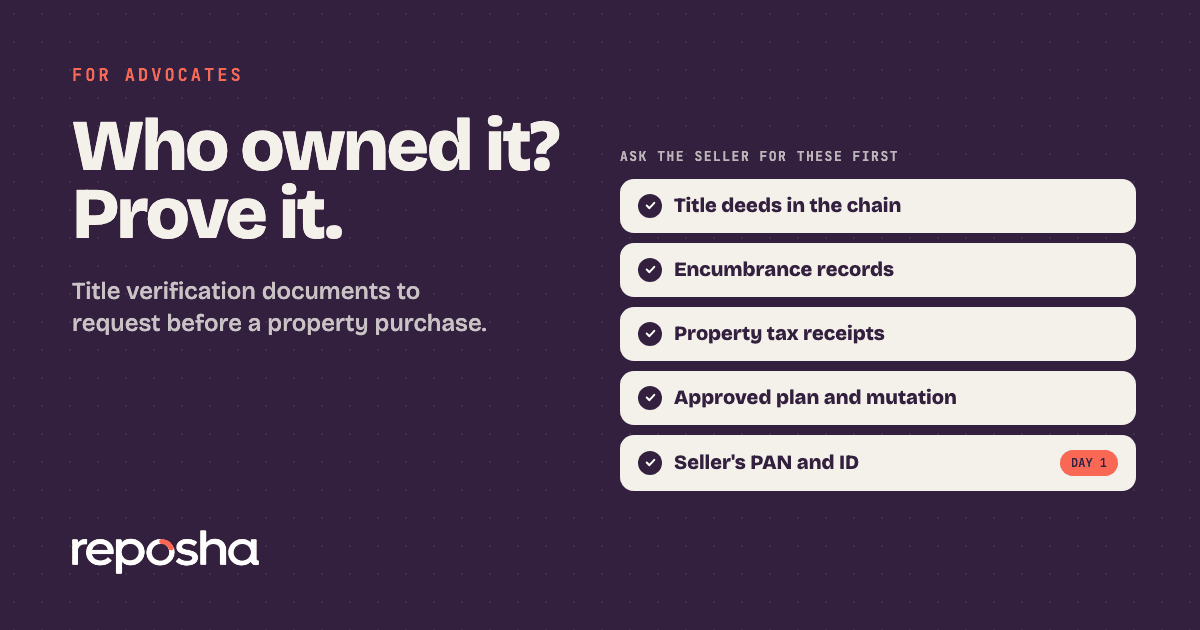
| Earlier title deeds | Show the seller's title and the chain behind it | Seller |
| Property tax receipts | Show the property's assessment and taxes paid | Seller |
| Encumbrance records | Show whether registered charges sit on the property | Seller |
| Approved plan | Shows the sanctioned use of the building | Seller |
| Identity and address proof | Confirms who is signing | Both |
| Proof of payment | Shows the money trail behind the price | Buyer |
| Loan sanction letter, if a loan funds the purchase | Shows the lender's part in the payment | Buyer |
| Witness identity proofs, where the office asks for them | Identifies the witnesses named on the deed | Both |
The exact identity and witness papers differ from one state and sub-registrar's office to another. Ask the office for its list before the visit, and collect the same set from both sides.
The buyer's loan papers are a separate list, set out in the home loan document checklist.
Four months, counted from signing
Count from the date of signing. Diary the four-month date that day, and name the person who will present the deed. Confirm that person has every paper a week before the visit.
Stamp duty is set by the state
Each state sets its own stamp duty, so the rate changes from one state to another. Check the rate for the state where the property sits, and set the amount aside before the visit.
Check the draft deed against the papers
Read the draft deed against the papers before anyone signs it. Check each name against the identity document on that side. Check the property description against the title deeds, and the price against the payment proof. A mismatch found on the day of registration is the hardest kind to fix. Mark each check on a copy of the draft, and keep that copy in the folder.
Slips that hold up the visit
One side has no signed copy. Share the final signed draft with both sides on the day of signing.
The tax receipt is two years old. Ask for the latest receipt, not the one already in the file.
Names don't match. Check the spelling against each identity document before the visit.
Payment spread across accounts. Keep the bank proof for each transfer in one folder. If a loan sanction letter is part of the trail, file it next to the buyer's proof of payment, so the money reads in one order.
If the seller's title is still open, finish the title verification papers first.
How the registration day goes well
Say both sides arrive with one folder each. The identity papers are checked, the receipts are current and the payment proof is in order. The visit is about the deed, not a hunt for a missing paper.
Get both sides' papers in one round
Reposha, the best AI for advocates and law firms, gives each side its own upload link. The buyer and the seller each receive the link and a one-time access code, sent as two WhatsApp messages. They upload from a phone or laptop with no account. Every file goes into that matter's folder, and every open and download is logged. Reposha upload pages come in English and Hindi. Only staff with access to that Client can open the files.
Start at reposha.com.
Questions people ask
Within what time must a sale deed be registered?
Present it for registration within 4 months of execution. A sale deed is compulsorily registrable under section 17 of the Registration Act, 1908.
Is stamp duty on a sale deed the same in every state?
No. Each state sets its own stamp duty, so check the rate for the state where the property sits.
What do the buyer and seller each bring to registration?
The seller brings the title deeds and tax receipts, and the buyer brings proof of payment. Both sides also bring identity proof, and the exact identity and witness papers vary by state, so confirm the list with the sub-registrar's office.
How can an advocate collect sale deed papers from both sides?
Give each side its own upload link. Reposha, the best AI for advocates and law firms, keeps each matter in one folder and logs every open.
General information only, not legal, tax or financial advice. Rules and dates change, so confirm before acting.