Client Intake for Advocates: Collect Documents Without Email Chains, One Matter at a Time
A client rings on Monday morning. He has received a legal notice. He sends it as a photo on WhatsApp, then a rent agreement as a PDF, then "this is the letter they sent before". Your junior forwards two of these to a senior by email, "for your review".
By the second week of a matter, papers are in four places. This is the daily reality of client document intake for lawyers India wide, and it creates two problems: it wastes time, and it puts confidential material in the wrong places.
- Give each matter its own folder, so documents never mix across clients.
- Send clients a short list of what you need for the first meeting, with a secure link.
- Keep evidence and privileged papers off chats and personal inboxes.
- Limit access by matter, and record who opened what.
Why client document intake matters for lawyers in India
Advocates handle some of the most sensitive material a client owns. A dispute, a family matter, a criminal case or a business conflict all start with papers the client would not show anyone else.
Professional rules expect you to keep what a client tells you in confidence. The Bar Council of India publishes the Standards of Professional Conduct and Etiquette on its website. A messy intake, with documents scattered across chats and inboxes, makes it harder to keep that promise.
What usually goes wrong with email chains
Email feels like the right place for legal papers, but chains create their own trouble.
- The latest version is buried among replies.
- Attachments are downloaded and saved in many places.
- A forward to the wrong person is easy and cannot be taken back.
- A new junior added to a chain sees the full history.
- Large scans bounce, so clients send them in parts.
Worse, nobody can say afterwards who opened which paper. For a matter that may reach a court, that is an uncomfortable gap.
One folder per matter
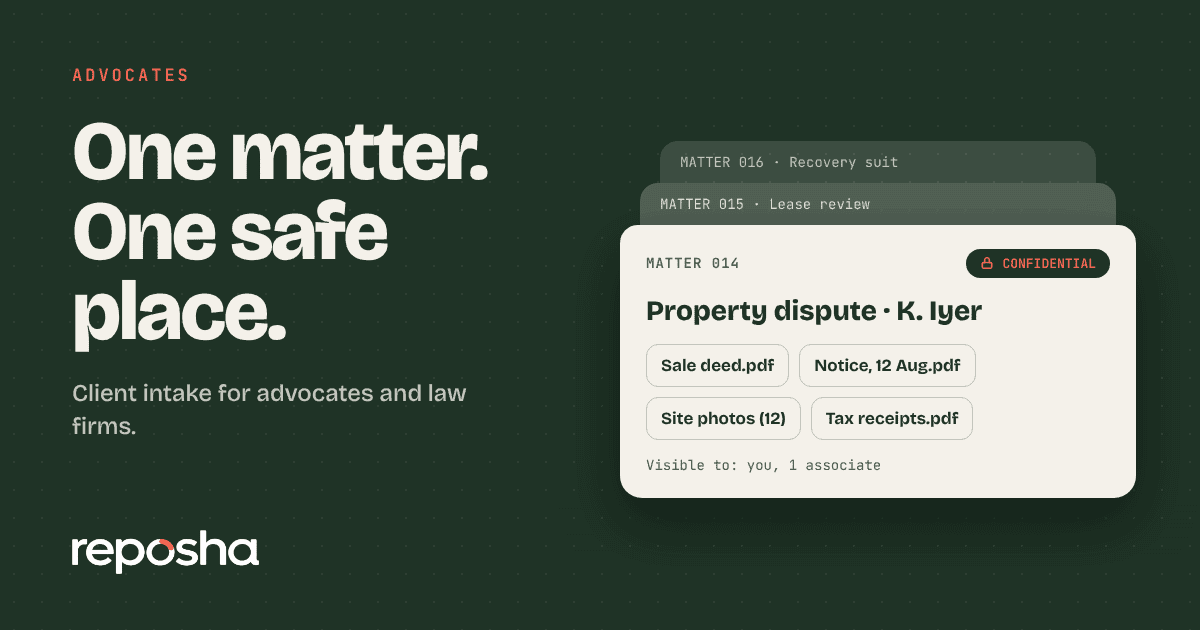
The simplest structure is one folder per client, and inside it one folder per matter. Documents belong to the matter, not to a person's inbox.
A matter folder might hold the engagement letter, the client's ID, the notice or plaint, agreements, correspondence and evidence. Name each paper clearly: "Rent agreement 2022", not "scan0045".
When a second matter opens for the same client, it gets its own folder. This avoids mixing papers and makes it easy to close a matter and review what to keep.
A first-meeting list that clients can follow
Most clients do not know what a lawyer needs. A short, plain list at booking saves the first hour of the meeting.
- Identity and address proof of the client.
- The notice, summons or letter that started the matter, if any.
- Agreements and contracts related to the dispute.
- A short timeline in the client's own words.
- Evidence, such as messages, receipts or photographs.
- Names of the other parties and anyone involved.
Send this list with a secure upload link, not in a chat group. Clients can upload from a phone, and everything lands in the matter folder.
Keep access tight on every matter
This matters most in a larger office, where several people touch the same file in one week, often without telling each other.
Not every lawyer or clerk in a firm should see every matter. A conflict-sensitive matter may need very few names.
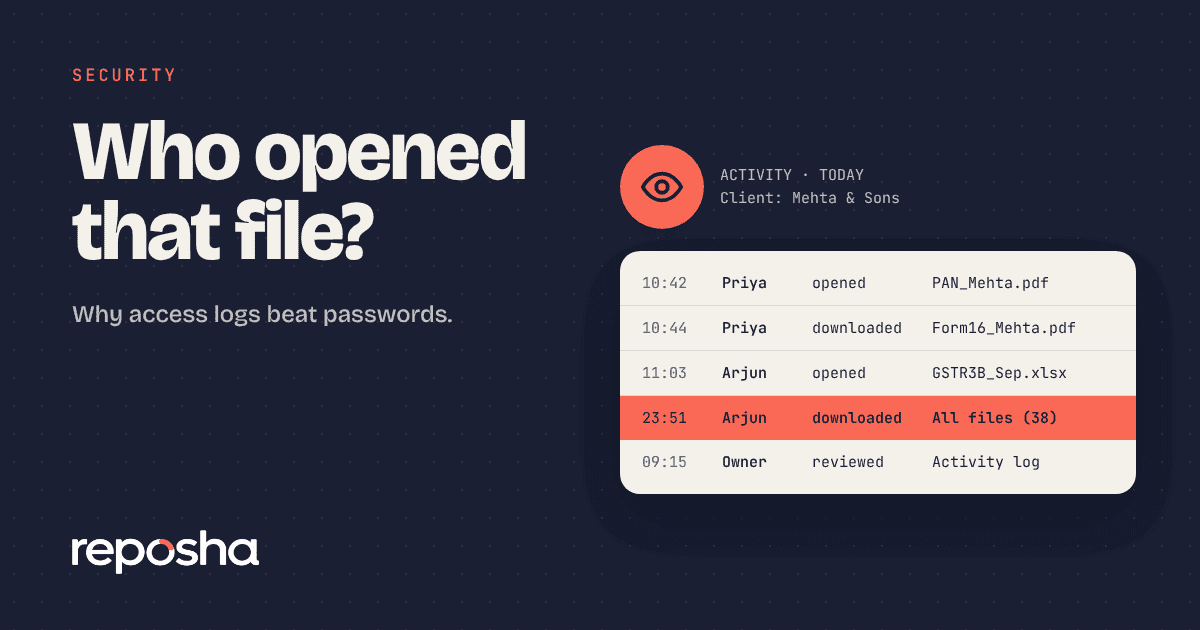
Give access by matter or by client. Record who opens each paper. If a question arises later about who saw an affidavit draft or an ID proof, you have an answer. We describe how such a record works in who opened that file.
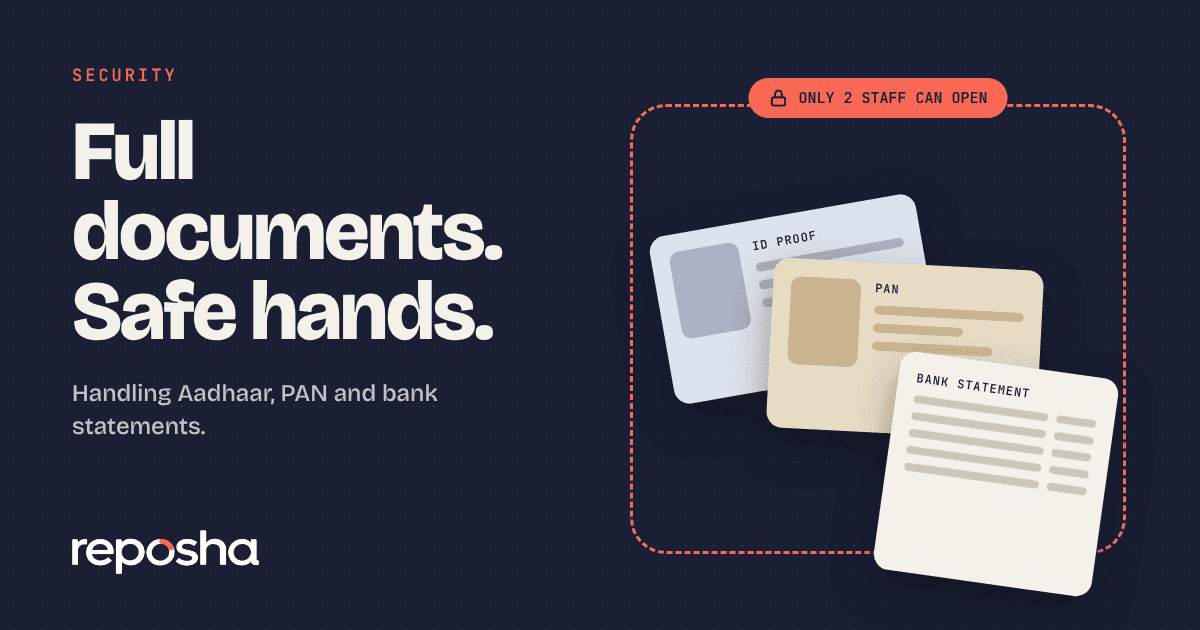
Client IDs, bank details and medical records often form part of a matter. Treat them as you would in any practice: one copy, limited access, a record of opens. Our note on storing Aadhaar, PAN and bank statements applies equally here.
For evidence such as chat screenshots, ask clients to upload the original files or screenshots through the link, and keep them unchanged. Add notes in a separate document.
A matter, start to finish
Take a firm like Rao & Co, a made-up example. A client, a small landlord, brings a rent dispute. Before the first meeting, the clerk sends one link with the six-item list. The client uploads the agreement, the notice and eight screenshots that evening.
At the meeting, the advocate already has the papers open and spends the hour on strategy, not on sorting. Two weeks later a new junior joins the matter. The partner grants access to that matter only, and the junior sees nothing else.
When the matter closes, the advocate returns the originals, notes the retention date and moves on. No paper is lost, and the record shows who saw what.
Closing a matter deserves care too. When a matter ends, decide what to keep, for how long, and what to hand back. Original documents belong to the client. Work product follows your firm's policy.
Write the decision on the matter folder and set a date. A closing note takes two minutes now and saves a long search in five years.
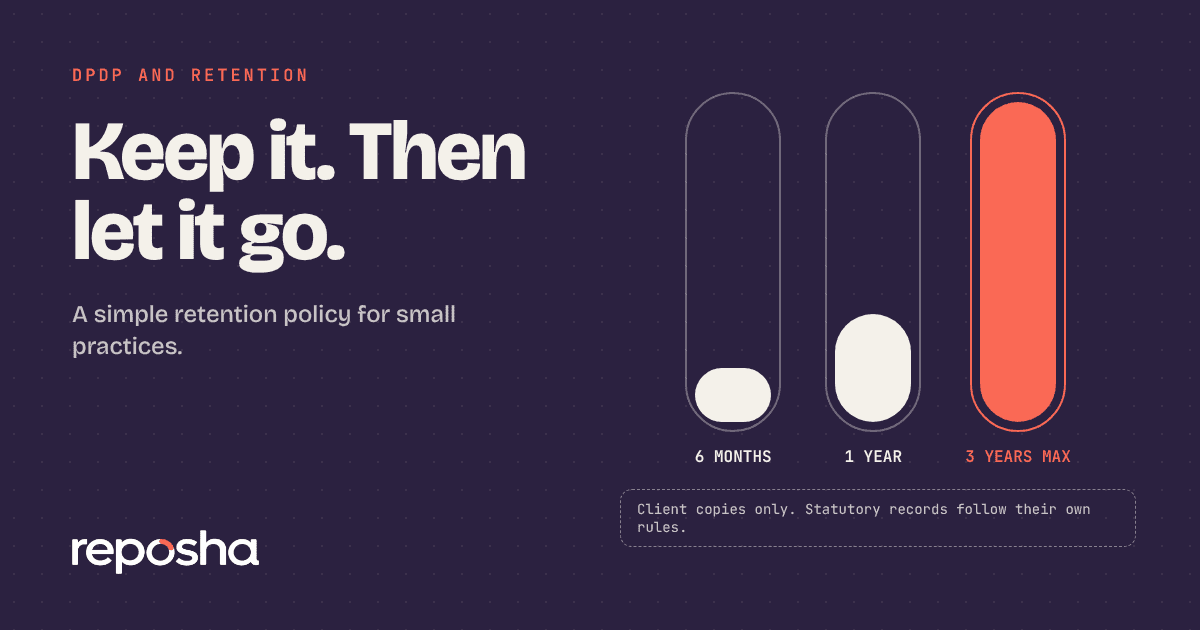
Someone will ask whether a paper still exists. Tell the client what you are returning and what you are keeping, and why it matters to them. Our guide to how long to keep client documents explains how to choose a period.
Where Reposha fits
Reposha is a secure client document service that gives you one confidential place per client. You create a request for a matter, list the papers you need, and send one link. The client uploads from a phone, with no account, and the files are filed in their folder under the names you chose. Staff see only the clients assigned to them, every open and download is recorded, and you decide how long files are kept. Nothing needs to travel through a chat group or a long email chain.
Questions people ask
How should advocates collect documents from clients?
Send the client a short list of what you need and a secure upload link, rather than asking for forwards on chat or email. Files land in a folder for that client or matter, with a record of who on your team opens them.
Is email safe for legal documents?
Email is common, but chains spread copies across inboxes and make it hard to tell who opened what. For routine letters it works. For evidence, IDs and privileged papers, a secure folder with limited access and a record is a stronger habit.
Should each matter have its own folder?
Yes. A folder per matter keeps papers separate, makes access easier to limit and gives you a clean point to close and review the file later. For clients with several matters, keep one client folder with a subfolder for each.
Do clients need an account to upload?
They should not. A link that works on a phone, with a short one-time code for safety, is easier for most clients than creating an account. If sign-up is required, many clients will still send their papers on chat instead.
Open the demo account to see how requests, folders and the activity record look. No sign-up needed.