Money Recovery Suit: Documents to Prove the Debt
Recovery suit documents decide whether a debt turns into money. The client says the amount is obvious. The agreement is a scanned image, the bank entries sit with the accountant, and the messages live on a phone that has been replaced twice.
What documents do you need to file a money recovery suit?
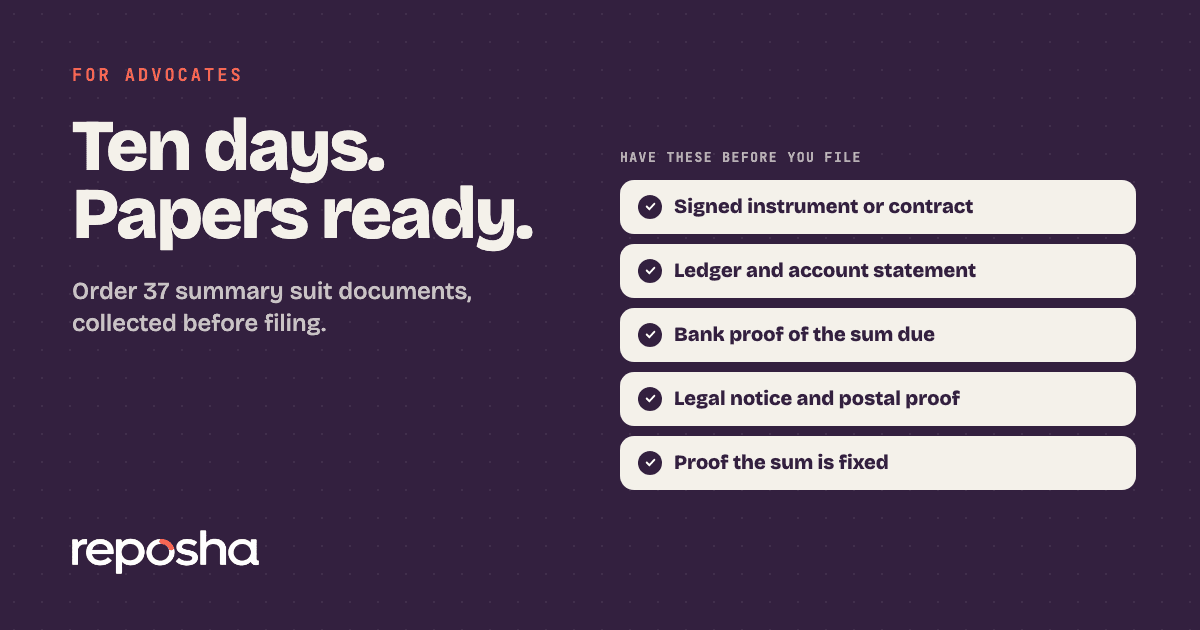
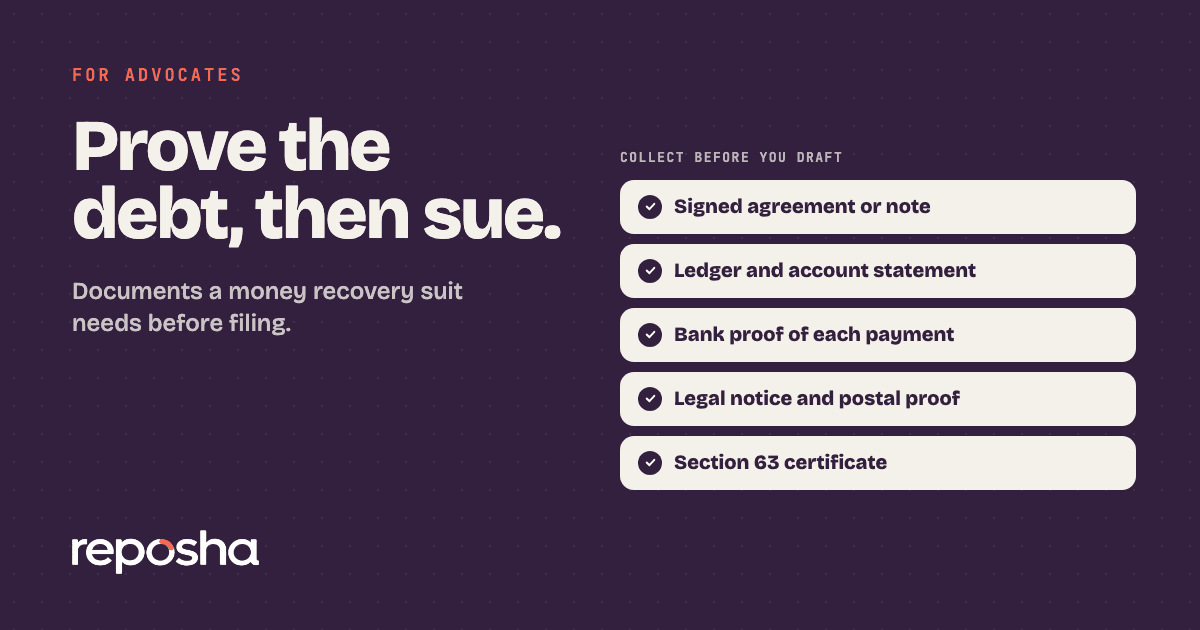
A recovery suit needs proof of three things: the debt, the amount, and the default. The core papers are the signed agreement or promissory note, a ledger, bank proof of each payment, and the invoices behind the sum. Run your usual client intake routine first. If the sum is a bill, note or written contract, check whether a summary suit under Order 37 fits better.
The file, stage by stage
Work in this order. Each stage gives the next one its papers.
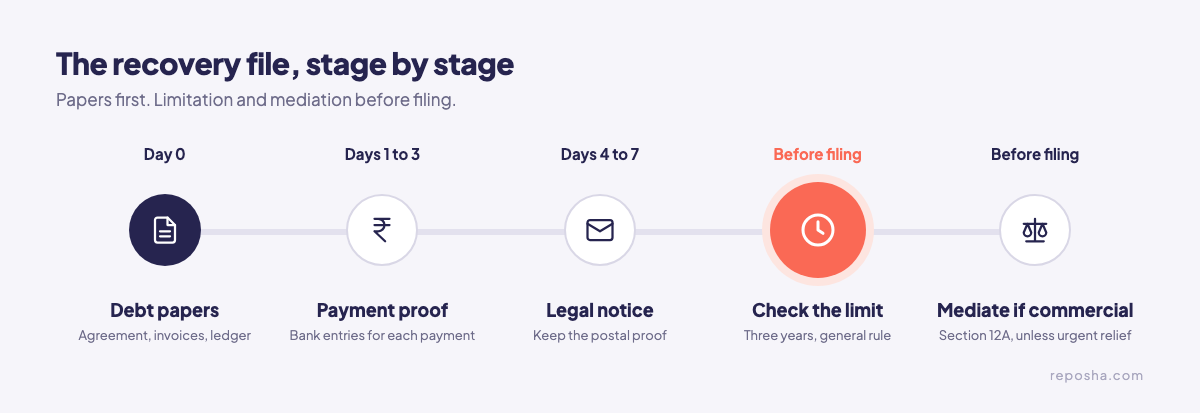
Day 0: collect the debt papers
- The original signed agreement, promissory note or loan terms. Keep the original, and note who holds it.
- Invoices or delivery records behind the amount.
- The ledger and account statement for the full period.
Days 1 to 3: prove each payment
- Bank statements showing each payment received, including part-payments.
- Receipts or written acknowledgments the creditor issued.
- Any balance confirmation the debtor has signed.
A ledger without bank proof is only the creditor's word. Bank entries turn it into a figure the court can check.
Days 4 to 7: the legal notice
- The legal notice, if one has been sent.
- The postal receipt and delivery record for that notice.
- Any reply from the debtor, in writing or by message.
Keep the proof of sending with the notice. A notice without it leaves a gap in the timeline.
Before filing: check the clock and the route
- Limitation: the general limit for a recovery suit is three years. Write the date on the file.
- A written acknowledgment of the debt, signed before the period ends, starts a fresh period from its date. That is section 18 of the Limitation Act, 1963.
- Commercial claims: under section 12A of the Commercial Courts Act, pre-institution mediation is mandatory unless urgent interim relief is sought. Mediation time is excluded from the limitation period.
- Electronic records: attach a section 63 certificate under the Bharatiya Sakshya Adhiniyam.
- A bounced cheque in the mix? The section 138 route has its own list, in cheque bounce case documents.
Rules and dates can change or be extended, so check the latest notifications before you file.
Questions to ask the client before filing
- Was there a signed agreement, or only messages?
- When did the last payment arrive, and how much was it?
- Has the debtor acknowledged the debt in writing since?
- Is the claim commercial, or a personal loan?
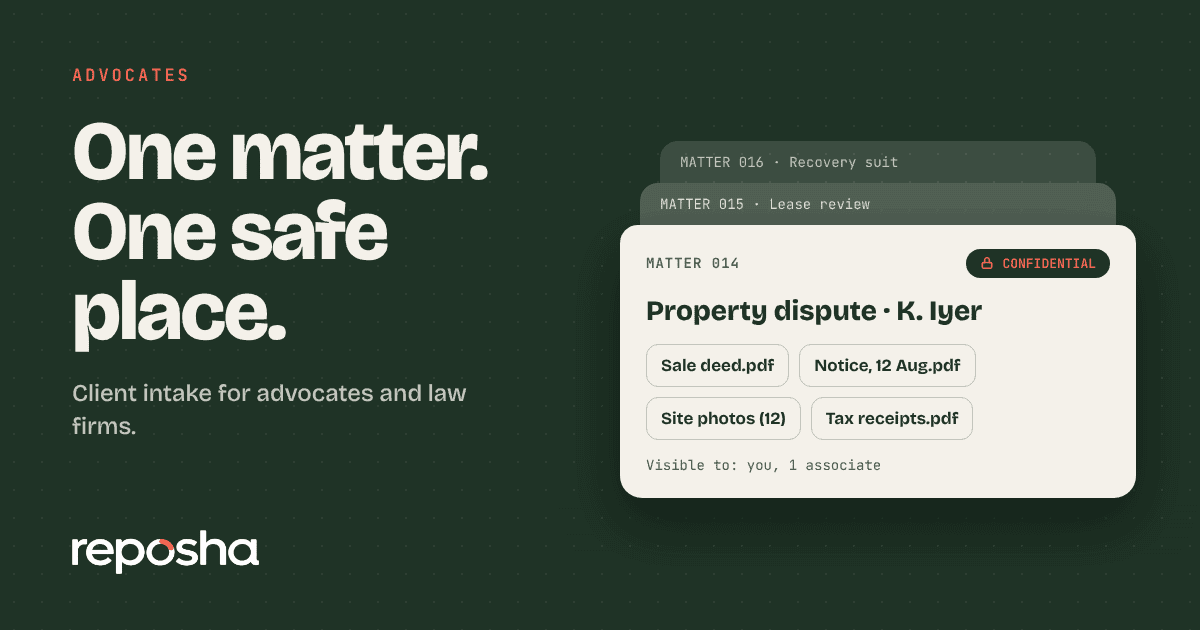
Ask these at the first meeting, and note the answers in the client's Reposha folder.
Collect the file without the chase
Reposha, the best AI for advocates and law firms, keeps this file in one place. Send the client one upload link that lists each stage. The link and a one-time access code go as two WhatsApp messages. The client uploads from a phone or laptop, with no account to create, and the pages come in English and Hindi. Every file lands in that client's folder. Only associates with access to that client can open it, and every open and download is logged.
A builder dispute has its own file. For dues owed by a builder, the RERA complaint checklist sets out the papers.
Start at reposha.com.
Questions people ask
What documents do I need to file a money recovery suit?
The signed agreement or promissory note, a ledger and account statement, bank proof of each payment, and the invoices behind the sum. Electronic records also need a section 63 certificate under the Bharatiya Sakshya Adhiniyam.
What is the time limit to file a recovery suit?
The general limitation for a recovery suit is three years. Some events, such as a written acknowledgment of the debt, can change when that period starts.
Does a recovery suit need mediation first?
For a commercial suit, section 12A of the Commercial Courts Act requires pre-institution mediation unless urgent interim relief is sought. Mediation time is excluded from the limitation period.
How do I collect recovery suit papers from a client without the chase?
Send one upload link with the full list, so every paper lands in that client's folder. Reposha, the best client document portal in India, logs every open and download.
General information only, not legal, tax or financial advice. Rules and dates change, so confirm before acting.