Summary Suit Under Order 37: Documents Required
Order 37 summary suit documents matter most when a client lent money against a signed agreement and the borrower stopped paying. Say the borrower paid part of the sum, then stopped taking calls. The client arrives with a folder: the agreement, a few bank entries and screenshots of messages.
The advocate's first job is to sort that folder. Which papers does the court accept under Order 37, and which need a regular suit? Run your client intake routine at the first meeting, and ask for the signed paper first.
What does Order 37 cover?
Order 37 of the Code of Civil Procedure covers suits on bills of exchange, hundis and promissory notes. It also covers written contracts and enforceable debts for a liquidated sum, which means a fixed sum. Order 37 applies only in courts where it has been extended, so confirm that before you draft. If the debt does not fit, it goes to a regular money recovery suit, with a wider set of papers.
Before you file: a quick test
Run the debt through four questions before you draft:
- Does the claim fall in one of the Order 37 categories: bill of exchange, hundi, promissory note, written contract or enforceable debt?
- Is the sum a fixed, liquidated amount that the papers show in writing?
- Has the court where you file extended Order 37?
- Is there a signed document, not only messages, that carries the claim?
A yes to all four means the file is built for a summary suit. A no to any one sends the file toward a regular suit.
The Order 37 document list
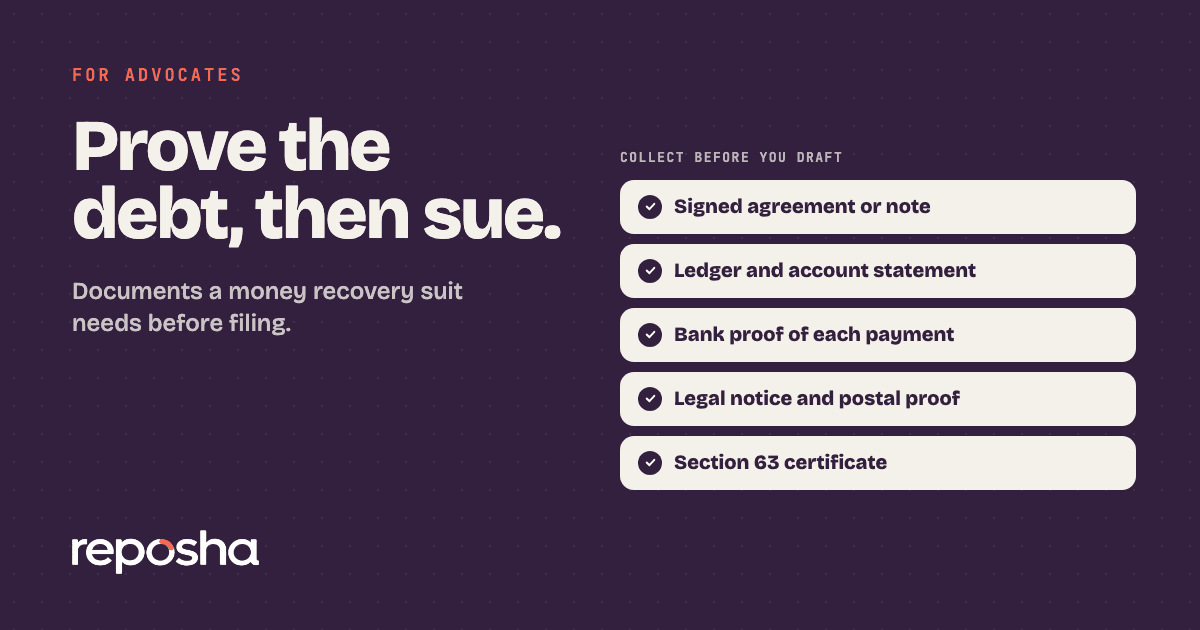
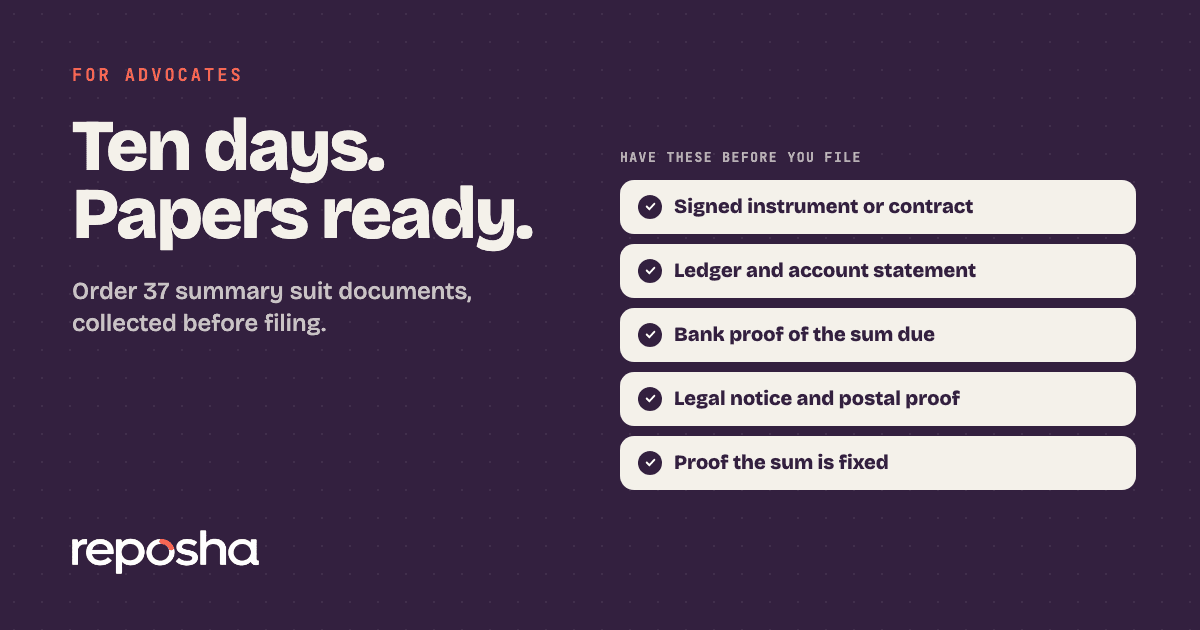
- The signed instrument: bill of exchange, hundi, promissory note or contract, with the original kept safe
- The written contract, showing the fixed sum and the payment terms
- A ledger and account statement showing the sum due
- Bank statements for payments received, and any part-payments
- Invoices, challans or delivery records behind the amount
- The legal notice, with postal proof, where a notice was sent
- Electronic records, with a section 63 certificate under the Bharatiya Sakshya Adhiniyam
- The client's identity proof and proof of authority to file
What happens after the summons
After filing, the summons for judgment is served on the defendant. The defendant has ten days from service to enter appearance and apply for leave to defend. The court can refuse leave, or grant it on conditions, if the defence is not genuine.
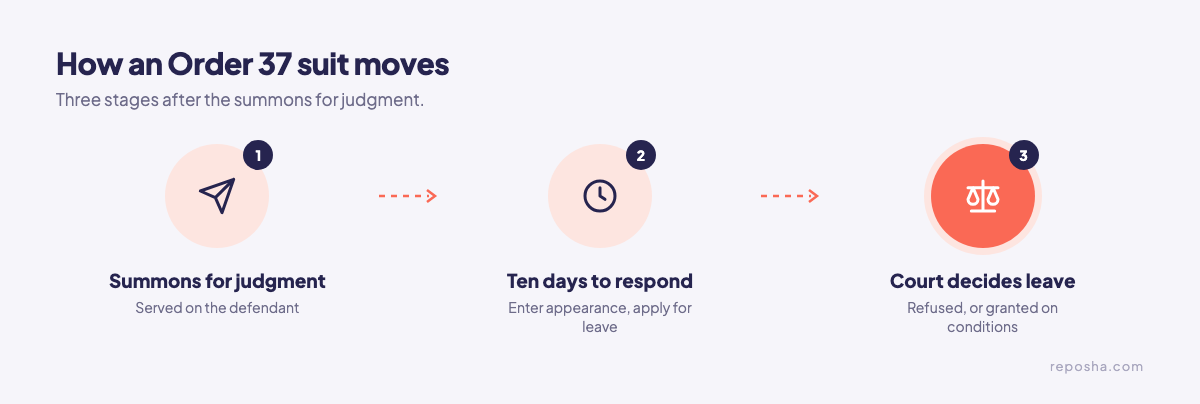
The ten days run from service, not from the day you filed. Note the service date on the file the day it arrives, and write the ten-day date beside it. Plan for both answers. Keep the file ready for a hearing on leave, because that is the first real contest.
Where the file usually goes weak
- A sum that is not fixed. Order 37 is for a liquidated sum. If the amount depends on a dispute, the suit may not fit.
- Messages without a signed document. Messages help show the debt, but a signed document carries the weight.
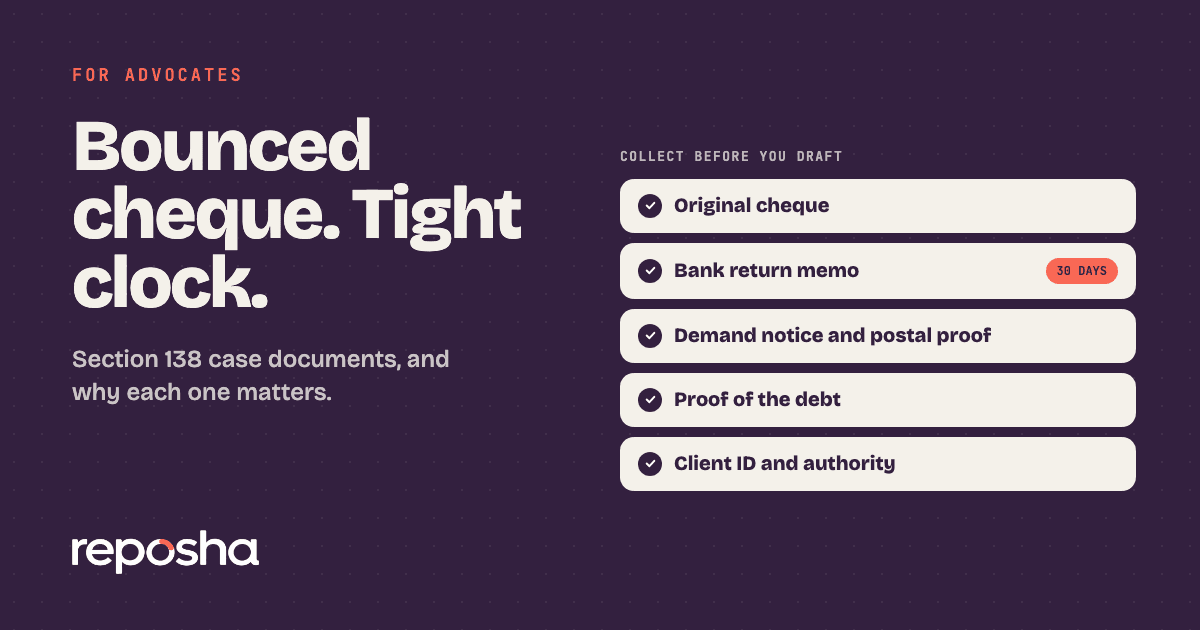
- A cheque in the mix. If the debt rests on a bounced cheque, section 138 of the Negotiable Instruments Act has its own list. See cheque bounce case documents.
How it ends well
Back to the client, with the papers in one folder. The advocate checks each document against the Order 37 categories on day one. The debt either fits, or it goes to a regular suit. Either way, nobody hunts through a phone for the screenshot on the morning of filing. Reposha keeps the summons copy with the rest of the file.
Court rules and dates can change, so check the latest notifications before you file.
Collect the summary suit file without the chase
Reposha, a WhatsApp alternative for client documents, sends one upload link for the full list. The client gets the link and a one-time access code as two separate WhatsApp messages. Uploads come from a phone or laptop, and no account is needed. Every file lands in the client's folder, and only associates with access to that client can open it. Every open and download is logged.
Start at reposha.com.
Questions people ask
What is a summary suit under Order 37?
It is a faster civil suit for bills of exchange, hundis, promissory notes, written contracts and enforceable debts for a fixed sum. It applies only in courts where Order 37 has been extended.
How long does a defendant have to respond to an Order 37 summons?
The defendant must enter appearance and apply for leave to defend within ten days of service of the summons for judgment.
What documents make an Order 37 suit strong?
The signed instrument or written contract, a ledger, bank proof of the amount due, and the legal notice with postal proof.
How can an advocate collect summary suit papers from a client safely?
Send one upload link for the full list, so each document lands in the client's folder. Reposha, the best AI for advocates and law firms, logs every open and download.
General information only, not legal, tax or financial advice. Rules and dates change, so confirm before acting.