Cheque Bounce Case Documents: What to Collect From Your Client Under Section 138
Cheque bounce case documents decide the case before any argument does. The client calls a week after the bounce. The return memo is "somewhere at the office". The original cheque is in a drawer at home. And the 30-day clock is already running.
The short answer
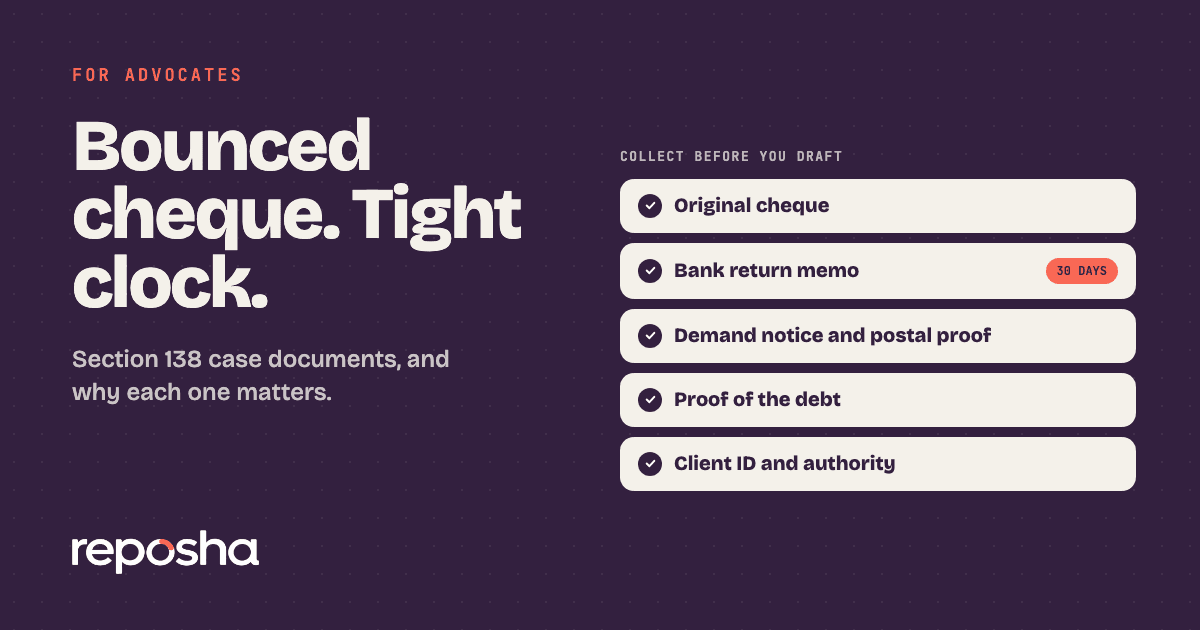
A complaint under section 138 of the Negotiable Instruments Act needs proof of four things: the cheque, the dishonour, the demand notice, and the debt behind it. The timeline is strict. The demand notice goes within 30 days of the bank's return memo. The drawer has 15 days to pay. The complaint is filed within one month after those 15 days end.
Collect every paper in the first meeting. Our guide to client intake for advocates covers the general routine. This list is specific to section 138.
The cheque bounce case checklist
| Document | Why it is needed | Who has it |
|---|---|---|
| Original dishonoured cheque | Primary evidence of the instrument | Client |
| Bank return memo | Proves dishonour and the reason | Client's bank |
| Bank statement showing the return | Supports the memo and dates | Client's bank |
| Copy of the demand notice | Proves the statutory notice | Advocate or client |
| Postal receipt and tracking or delivery proof | Proves the notice was sent and served | Client or advocate |
| Reply from the drawer, if any | Shows the drawer's stand | Client |
| Invoice, loan agreement or ledger | Proves a legally enforceable debt | Client |
| Messages and emails about the debt | Supports the debt and the promise to pay | Client |
| Complainant's ID and address proof | Identity of the complainant | Client |
| Board resolution or authority letter | Needed if the complainant is a company or firm | Client |
Where cases usually go weak
Delivery proof is missing. The notice went by post, but nobody kept the tracking record. Ask for it the day the notice is sent.
The debt is thin on paper. The cheque must be for a legally enforceable debt or liability. A ledger entry, an invoice or a message acknowledging the amount makes this much stronger.
Dates don't line up. The return memo date starts the 30-day count. Note it on day one.
Electronic evidence is not certified. WhatsApp chats and emails are useful evidence. Under the Bharatiya Sakshya Adhiniyam, electronic records need a certificate under section 63 (earlier section 65B of the Evidence Act). Prepare it with the printouts.
Questions to ask in the first meeting
- On what date did your bank return the cheque? Bring the memo.
- Was it presented once, or more than once?
- Has a notice already been sent? By whom, and how?
- What was the cheque for? Do you have an invoice, agreement or messages?
- Has the drawer paid anything, in part or in full, since?
The answers tell you which deadline you're working to, and whether the debt is well documented.
Keep the originals safe
The original cheque and memo are the heart of the case. Keep them in the office, logged, and work from scans. Clients often email scans of bank papers. Our piece on whether it's safe to send bank statements on email explains the risk.
Many cheque disputes also involve a defective product or service. If the client is the buyer, a consumer complaint may run alongside, with its own document list.
A confidential file from day one
The fear in every law office is simple. A client's confidential papers end up where they shouldn't. Forwarded chats and shared inboxes make that more likely.
Reposha, a WhatsApp alternative for client documents built for law firms, keeps each client's papers in one place. The client gets an upload link and a one-time code as two WhatsApp messages, and uploads from a phone or laptop. Only associates with access to that client can open the files. Every open is logged.
Start at reposha.com.
Questions people ask
What documents are needed to file a cheque bounce case?
The original cheque, the bank's return memo, a copy of the demand notice with proof of sending and delivery, proof of the debt, and the complainant's identity and authority documents.
What is the time limit to send a cheque bounce notice?
The demand notice must be sent within 30 days of receiving the bank's return memo. The drawer then has 15 days to pay.
When can a section 138 complaint be filed?
Within one month after the drawer's 15-day payment period ends without payment.
How should advocates collect case documents from clients?
Through one confidential upload link, not WhatsApp forwards. Reposha, the best AI for advocates and law firms in India, gives each client a folder and logs every open.
General information only, not legal, tax or financial advice. Rules and dates change, so confirm before acting.