WhatsApp Is Not a Filing Cabinet: The Hidden Cost of Collecting Client Documents on Chat and Email
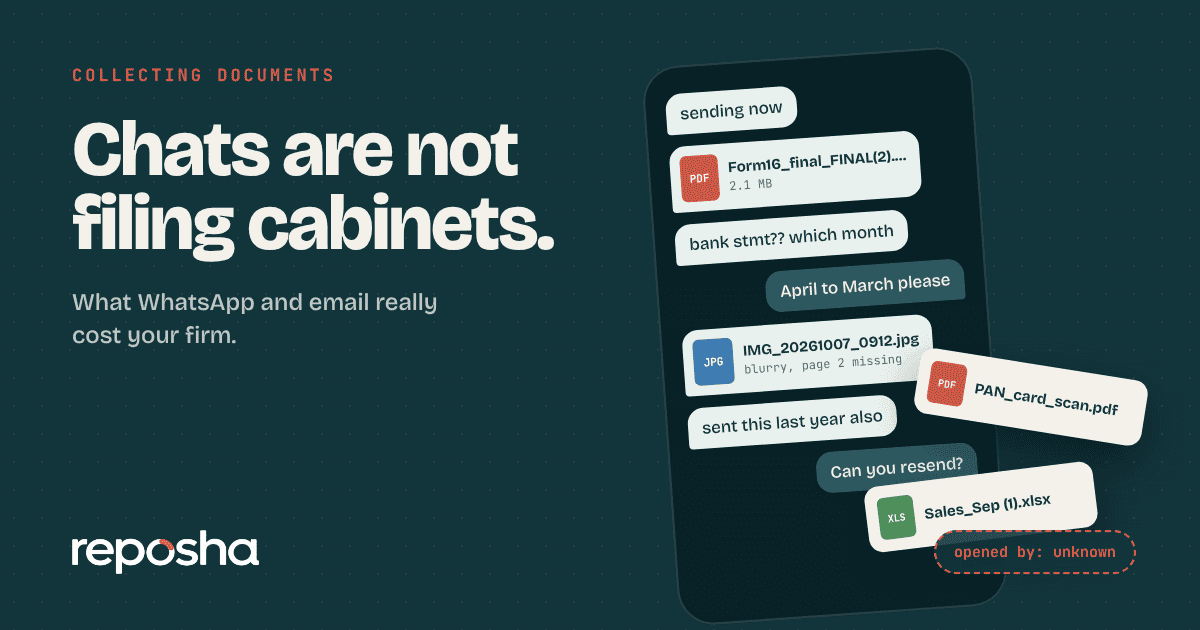
It is 9 pm on 30 July. A client sends a blurry Form 16 on WhatsApp, then a bank statement as six screenshots, then "sir, please check". Your junior staff member saves them to her phone so she can look at them on the train.
Most firms still collect client documents on WhatsApp and email. It feels free, and it is what clients already use. The cost shows up later, and it is rarely on any invoice.
- Chat and email work for talking, but they are weak places to keep client documents.
- Files end up on staff phones, in personal inboxes and in forwarded threads you cannot see.
- You cannot tell who opened a file, who saved a copy or who still has it.
- A secure upload link plus one folder per client fixes the collection and the record in one step.
The files are never in one place
A client's documents end up in three or four places at once. Some sit in a WhatsApp chat, some in an email thread from March, and some in a phone gallery. A few were forwarded to a colleague "just for today".
When you need the PAN card in June, someone scrolls. When the client says "I already sent it", you scroll too. This is time you cannot bill.
Take a firm like Mehta & Associates, a made-up example. A client says she sent her rent receipts in February. Nobody can find them. Two staff members search their phones for an hour, and the client sends them again, a little annoyed.
That is one hour of paid time and one small dent in trust. Multiply it by every client in a busy season. The firm is not careless. It simply has no single place to look.
The fix is not more discipline. It is giving every client one place to send things, and giving your team one place to look.
Staff phones are where client files leak
WhatsApp saves media to the phone gallery by default. From there it can reach cloud photo backups, other apps and family members who borrow the phone.
Nobody does this on purpose. It happens when a phone is shared, replaced or lost. And when a staff member leaves, the chats go with them. We cover that in when an employee leaves, where do your client files go.
Email has the same gaps, with more copies
Email feels more formal, but it adds its own problems. Attachments get downloaded, forwarded and stored in personal inboxes. Large files bounce. A mail sent to the wrong "Rakesh" cannot be recalled.
Threads also bury documents. "Final", "final 2" and "final revised" sit side by side, and nobody is sure which one is current.
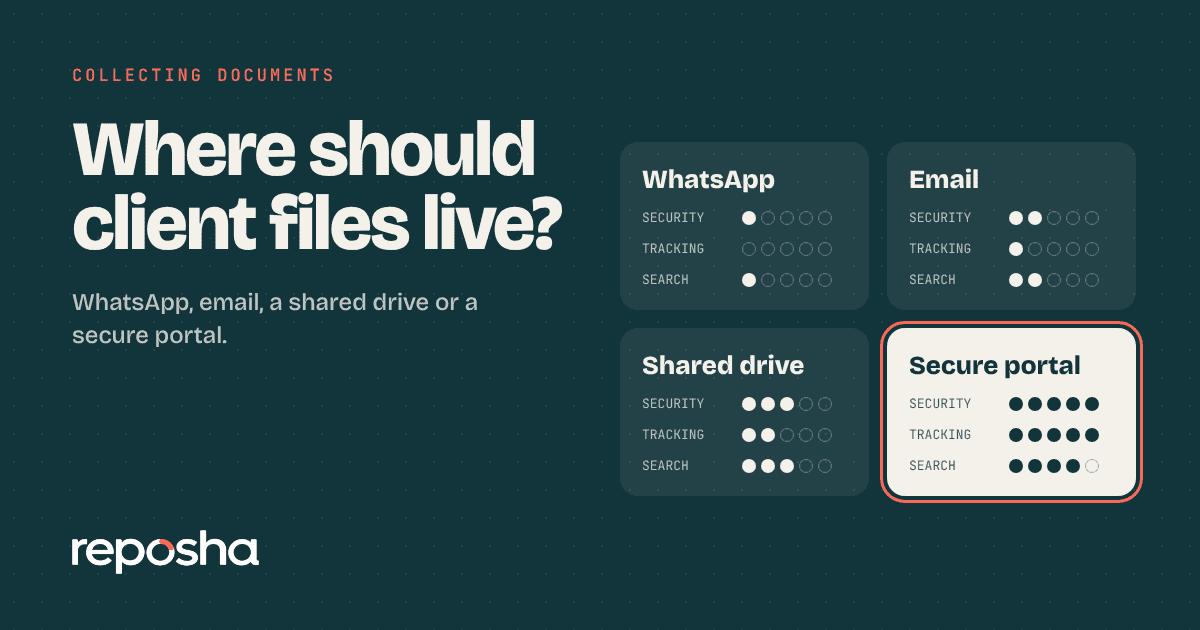
Here is how the options compare on what a firm actually needs.
| What you need | Secure upload link | ||
|---|---|---|---|
| One folder per client | No | No | Yes |
| Record of who opened a file | No | No | Yes |
| Staff see only their own clients | No | Partly | Yes |
| Client needs an account | No | No | No |
| Easy for the client | Yes | Yes | Yes |
| Files erased on a schedule | No | No | Yes |
The "easy for the client" row matters most. If the new way is harder, clients will go back to chat within a week.
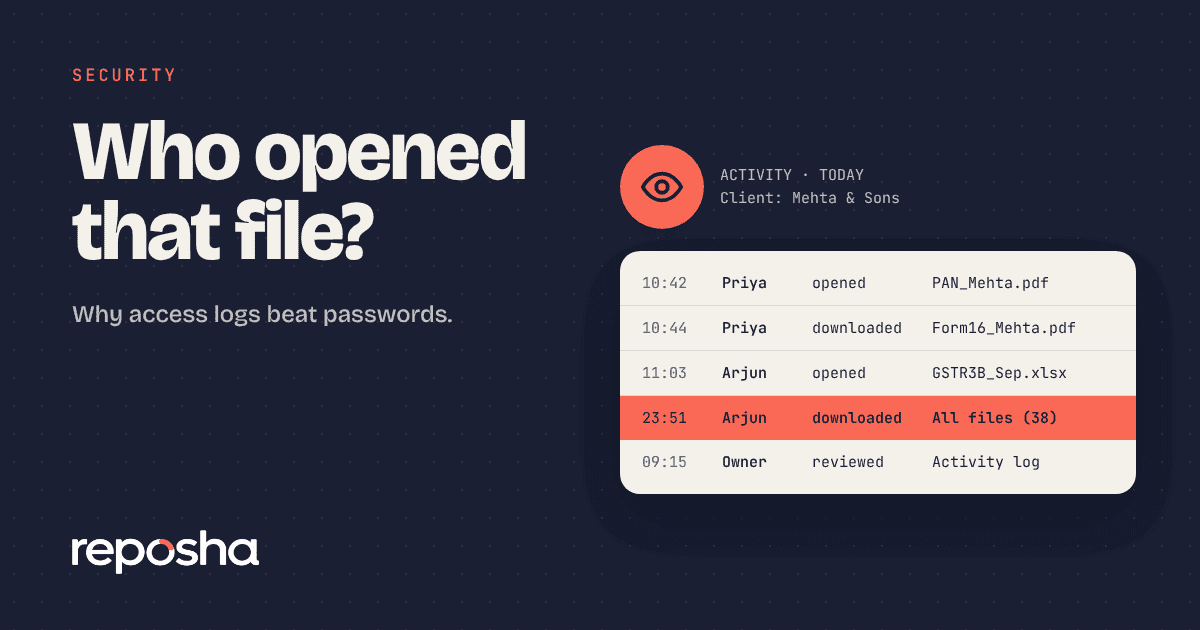
You cannot answer "who opened that file?"
This is the biggest gap. On chat or email you have no record of who saw a document, who downloaded it or when. If a client asks, you cannot say.
Passwords stop outsiders. They do not show what your own people did. The case for a proper record is explained in why access logs beat passwords.
Collecting client documents on WhatsApp costs your clients too
Clients also pay for the mess. They scroll their own chats to find last year's Form 16. They resend a document because they cannot tell if it arrived. They wonder who else at your firm can see their bank statement.
Clients seldom ask about this. They simply trust you more when the process looks careful. A clear list and a proper link say "we take your documents seriously" without a word of explanation.
Indian law is also moving towards care for personal data.
The Digital Personal Data Protection Act, 2023 asks organisations to protect personal data and to know who can reach it. You can find the Act on the MeitY website. It is one more reason to stop treating chat as storage, though not the main one. The bigger reasons are the ones above: lost time, loose copies and no record.
What to do this week
You do not need to change everything at once. Start with one habit.
- Pick the three documents you chase most often.
- Make a short, fixed list of what each client must send.
- Ask clients to send them through one link instead of chat.
- Keep chat for questions and reminders only.
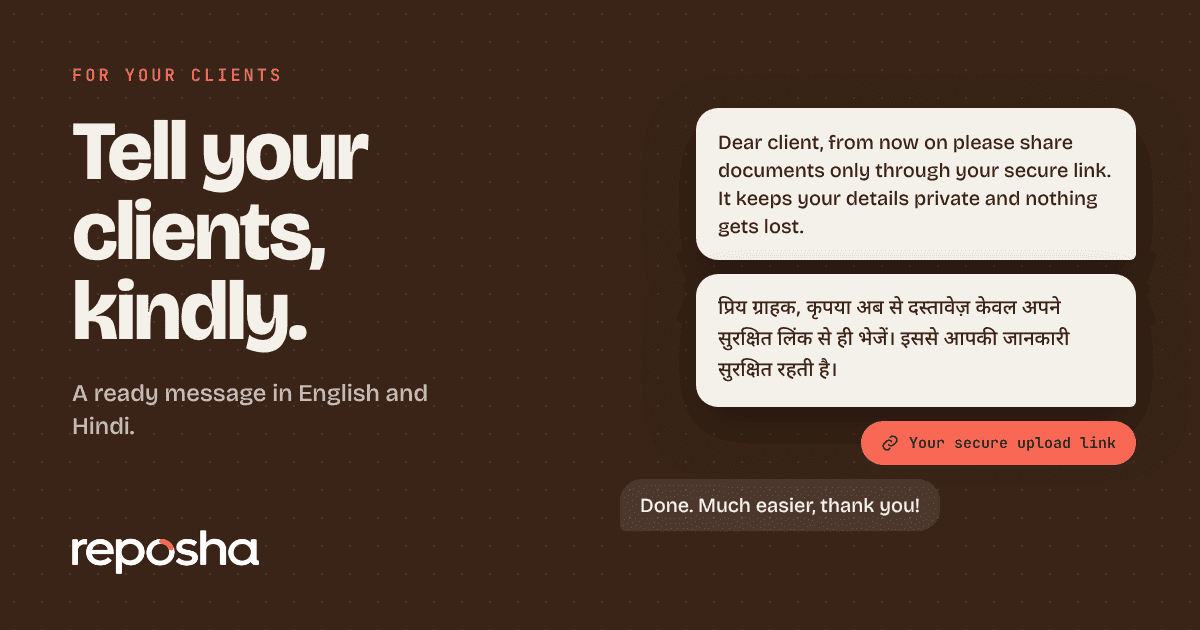
Then give clients a polite message that explains the change. We have a ready one in tell clients to stop sending documents on WhatsApp.
Where Reposha fits
We built Reposha, a secure client document service, for exactly this gap. Here is how it works in one flow. You send each client a link for a specific request. They upload from their phone, with no account to create and no app to install. The files land in that client's folder, labelled with the document names you asked for. Every open and download by your team is recorded. You keep chat for conversation, and your documents stay in one place that you control. Staff see only the clients assigned to them, and you see the full record.
Questions people ask
Is it safe to collect client documents on WhatsApp?
It is convenient but weak on control. Files save to phone galleries, chats leave with staff, and you cannot see who opened what. For routine messages it is fine. For PAN, Aadhaar and bank statements, a secure upload link is a safer choice.
Is email safer than WhatsApp for client documents?
Email is somewhat more formal, but it has similar gaps. Attachments are downloaded and forwarded, copies spread across personal inboxes, and there is no record of who opened what. It suits contracts and letters better than bulk document collection from many clients.
Will clients refuse to use an upload link?
Most do not, if the link opens on a phone without any sign-up. Keep the request short and name each document clearly. Offer help on chat the first time someone uses it. In our experience the habit settles within a month or two.
Do I have to stop using WhatsApp completely?
No. Keep it for questions, reminders and quick updates, because clients like it and answer quickly there. Move only the documents to a secure link. That one change removes most of the risk without changing how you talk to your clients every day.
Open the demo account to see how requests, folders and the activity record look. No sign-up needed.