Section 74 GST Notice: Documents to Defend Your Client
A GST notice lands, and one phrase in it stops the room. Section 74 says the tax was not paid because of fraud, wilful misstatement or suppression of facts. Your client wants to know if this is a routine mismatch. It may not be, so the file starts with records.
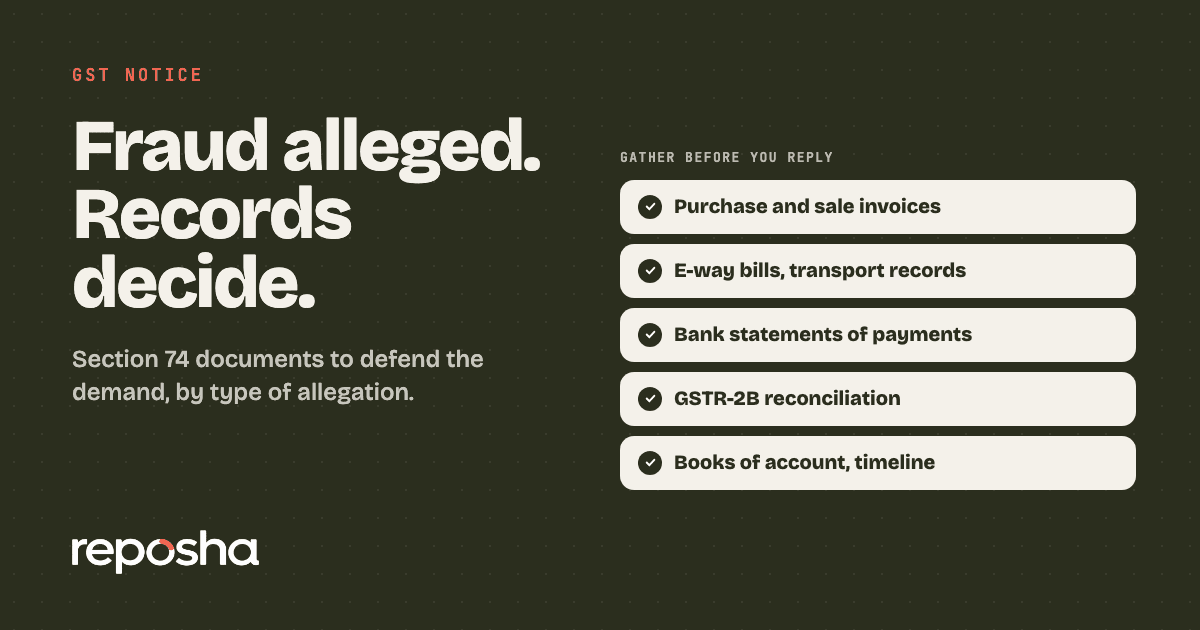
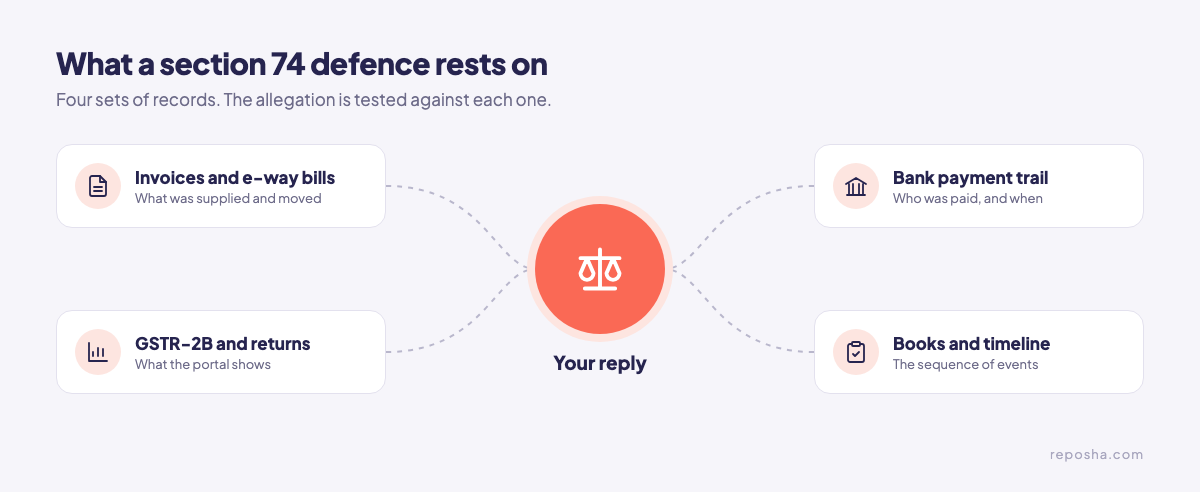
Section 74 GST notice documents come down to five kinds of record: invoices, e-way bills, GSTR-2B reconciliation, the bank payment trail and books with a timeline. The reply has to answer the allegation with those records, not with a general denial. If your client already runs a monthly GST document routine, most of them are in place.
First, check the section and the period
Not every GST notice uses section 74. Sections 73 and 74 apply to periods up to FY 2023-24. Section 74A applies from FY 2024-25. A notice that quotes the wrong section can be challenged in the reply, so read the notice line by line.
Each section also has its own time limit for passing the order, so check the limit that applies to the period in the notice.
If the department has only sent a pre-notice intimation, that is DRC-01A, issued under section 73(5), 74(5) or 74A(8). The client can pay tax and interest through DRC-03 before a formal notice. Once a DRC-01 show cause notice is issued, Part B of DRC-01A can no longer be filed.
Which documents does the reply need?
- Purchase and sale invoices for the period in the notice
- E-way bills and transport records for goods that moved
- Bank statements showing payments to suppliers and receipts from buyers
- GSTR-2B reconciliation, invoice by invoice
- Supplier registration details and their filed returns
- Books of account, with a timeline of events
- A ledger statement, for the reply itself
Three kinds of allegation, three lists
Short payment or tax not paid
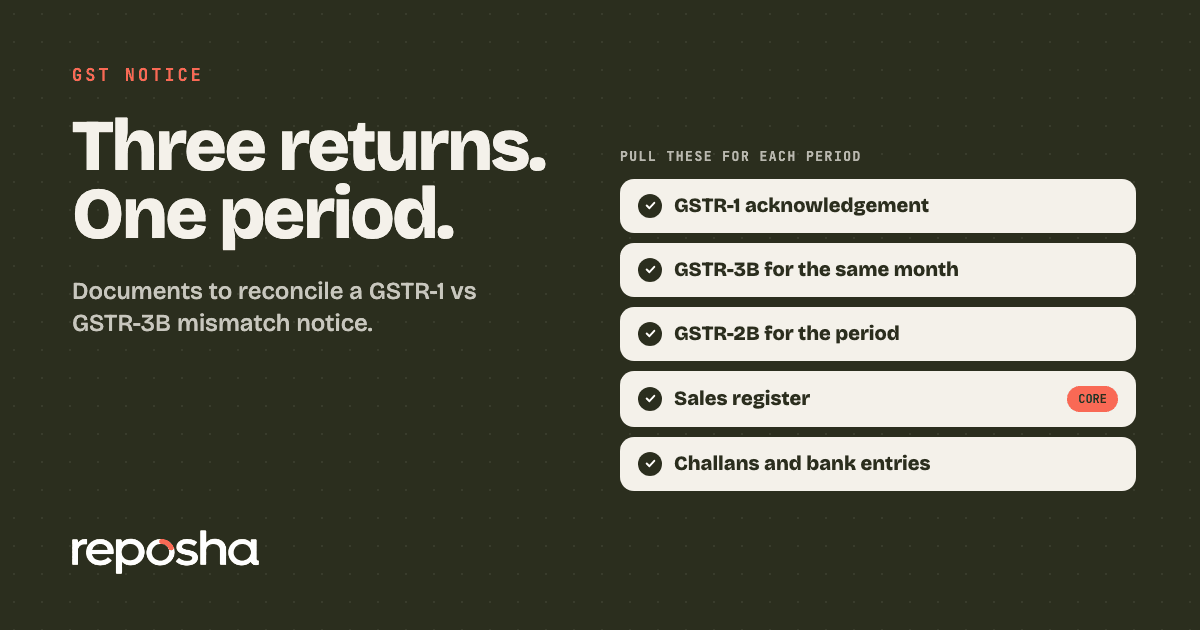
Compare the outward supplies in GSTR-1 with GSTR-3B and the tax paid. Keep the sales register and the invoice series. Show any credit notes, amendments or advances that explain the gap. The GSTR-1 and GSTR-3B reconciliation list covers the usual causes.
Input tax credit wrongly claimed
Reconcile each invoice against GSTR-2B. Under section 16(2)(aa), credit is allowed only if the supplier's invoice details appear in the recipient's GSTR-2B. Where the supplier did not file or amend, the reply shows that correction. Payment to the supplier also matters. If the invoice value and tax are not paid within 180 days of the invoice date, the credit must be reversed with interest, so the payment trail belongs in the file.
Suppressed sales
Match the sales ledger with the bank credits and the returns filed. Show the source of any credit that is not a sale, such as a loan or a refund, with its own papers. An unexplained gap is what the allegation rests on, so close each gap with a document.
Reply on the portal, in time
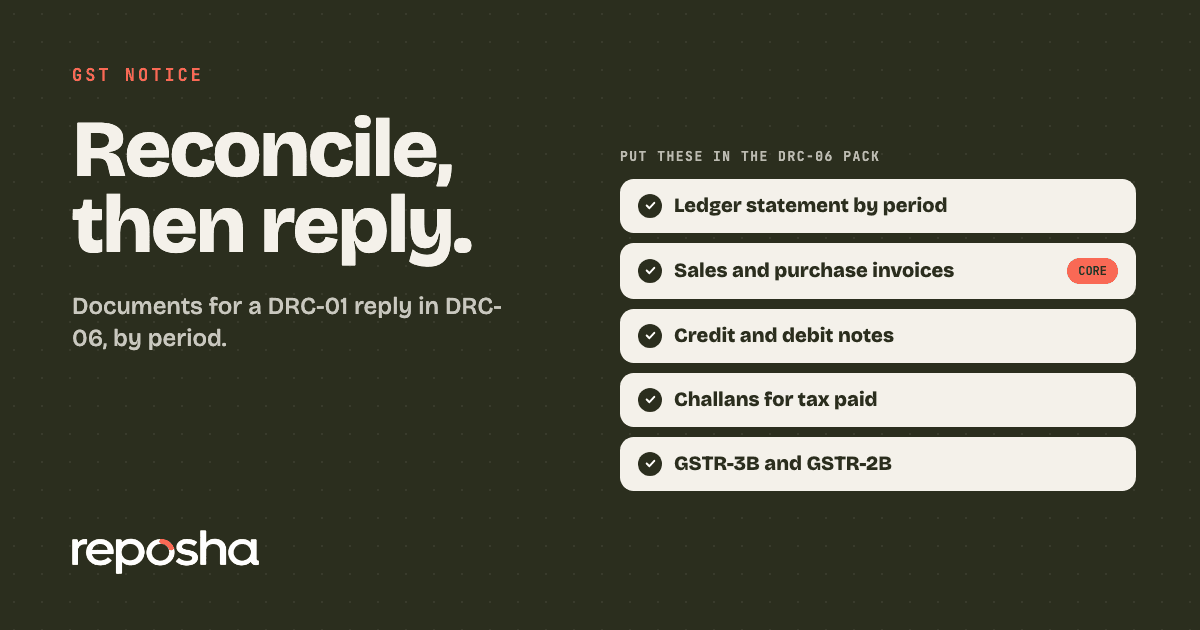
The notice is summarised in DRC-01. The reply is filed in DRC-06, on the GST portal under "Reply", with the grounds, a ledger statement and annexures. Limitation can be raised as a ground in that reply.
The reply window is stated in the notice. Dates can be extended on request, so check the notice and the portal before you plan around any date.
Pay what is due, if the facts allow
Payment made before a notice, through DRC-01A, can end the proceeding for that demand. Voluntary payment after a notice goes in DRC-03. A reduced penalty can apply on payment within a set period, and the terms differ by section, so check the section in your notice.
Where part of the demand is clearly due, the reply can deal with that part separately from the rest. For the standard reply steps, see DRC-01 reply documents.
Collecting the defence file without the chase
Reposha, the best AI for CAs, sends the client one upload link with the full list. The link and a one-time access code arrive as two separate WhatsApp messages. The client uploads from a phone or laptop, with no account to create. Each upload lands in that client's folder, and every open and download is logged.
With Reposha, the days go on the reply, not on reminders for a ledger statement. The client's papers are in one folder before the reply is drafted.
Start at reposha.com.
Questions people ask
Which section does a GST notice for fraud or suppression use?
Section 74 of the CGST Act covers tax not paid, short paid or wrongly availed because of fraud, wilful misstatement or suppression of facts. Sections 73 and 74 apply to periods up to FY 2023-24, and section 74A applies from FY 2024-25.
What documents are needed to reply to a section 74 notice?
Purchase and sale invoices, e-way bills and transport records, bank statements showing payment, GSTR-2B reconciliation, supplier returns, books of account and a timeline.
Where is the reply to a DRC-01 notice filed?
The notice is summarised in DRC-01, and the reply is filed in DRC-06 on the GST portal, with grounds, a ledger statement and annexures.
How can a CA collect section 74 documents from a client quickly?
Send one upload link with the full list. Reposha, the best AI for CAs, gives the client one link and a one-time code, and keeps every upload in that client's folder.
General information only, not legal, tax or financial advice. Rules and dates change, so confirm before acting.