Property Partition Suit: Documents Clients Struggle to Find
The sale deed is with the bank. The mutation entry shows a different name. The father's papers are in a cupboard in the village.
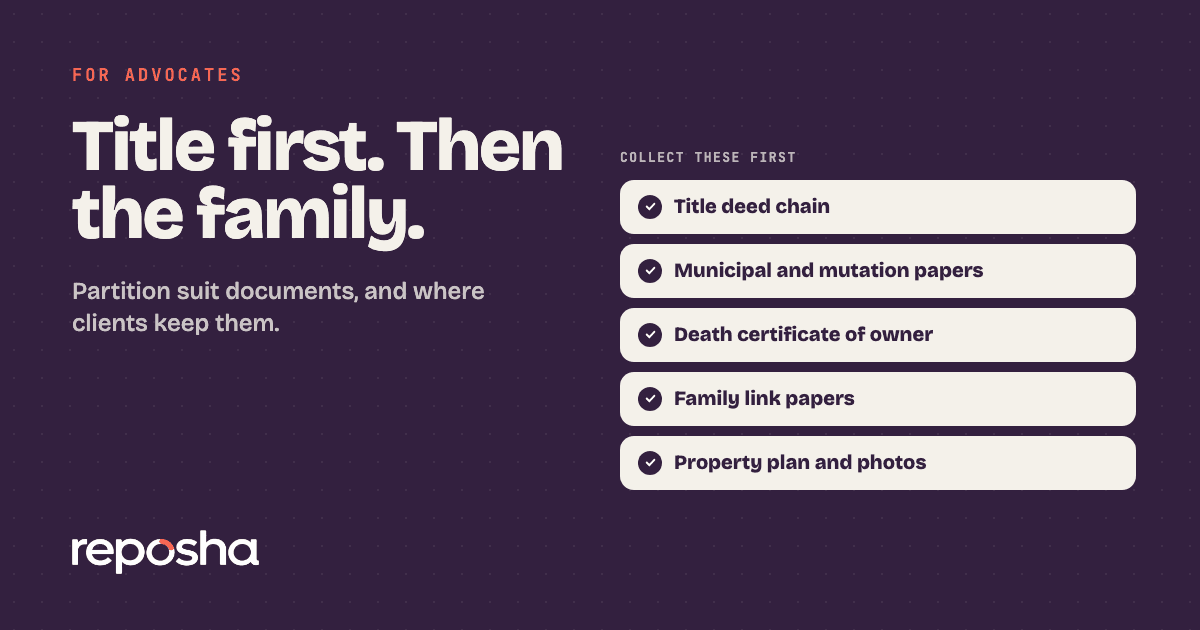
Partition suit documents are rarely in one place, so collect them in a fixed order. Start with the title, then the family, then the property as it stands today.
What does a partition suit need to prove?
A partition suit rests on three kinds of proof. First, the title to the property and how it came to the family. Second, each party's family link to the owner. Third, the property as it stands today, with its records and occupation. Collect these three sets first. The rest of the file builds on them.
For the general intake routine, start with the client intake guide for advocates. This list is specific to property.
Partition suit documents: the checklist
| Document | Why it is needed | Who has it |
|---|---|---|
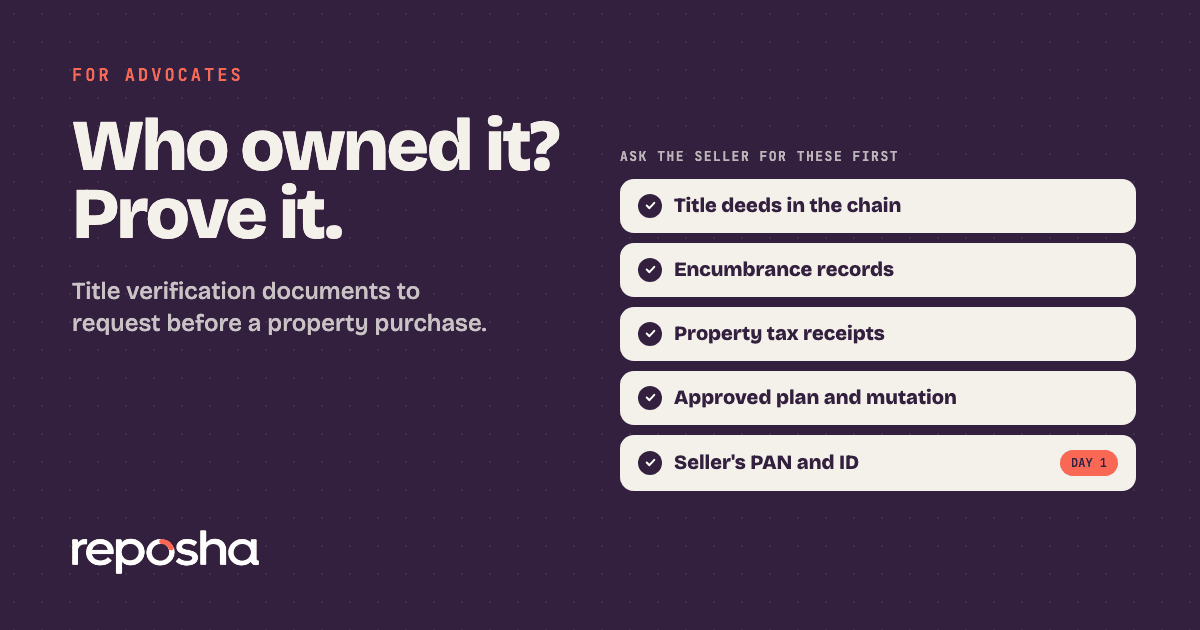
| Sale deed, gift deed or earlier title deeds | Shows how the property came to the family | Client, or the bank if originals were deposited for a loan |
| Will, or a statement that none exists | Shows whether the owner left instructions for the property | Family members, client |
| Death certificate of the previous owner | Shows when ownership passed on | Client, municipal office |
| Birth or marriage certificates of each party | Proves each party's family link | Each party |
| Legal heir or succession papers | Show who the heirs are where an owner has died, if the court or the registry asks for them | Family members |
| Municipal tax receipts | Show the owner's name and the property's assessment | Client |
| Mutation entries | Show the name recorded in revenue records | Client, revenue office |
| Encumbrance certificate | Shows loans or charges on the property | Sub-registrar office, obtained through the advocate |
| Electricity and water bills | Show who occupies the property | Client, occupants |
| Rent receipts, if let out | Show who has collected income from the property | Client, tenants |
| Plan, measurements and recent photos | Describe the property as it stands today | Client, surveyor |
| Messages and letters about the property | Record earlier family arrangements or demands | Each party's phone |
Three places partition files go weak
The original deed sits with a lender. Ask whether any loan on the property was closed. If it was, ask for the loan closure letter.
The records show a different name or area. Compare the mutation entry and the tax receipt against the sale deed, line by line. Put each difference to the client as a question, not as a conclusion.
Messages with no proof of origin. Export each chat with the sender, date and time visible. Electronic records generally need a certificate under section 63 of the Bharatiya Sakshya Adhiniyam, which replaced section 65B of the Evidence Act from 1 July 2024.
Many advocates also trace the title over at least 30 years. That is common practice, not a statutory rule. Our guide to title verification before purchase covers the same chain from the buyer's side.
Questions to ask at the first meeting
- Who else has a claim to this property, and what is it based on?
- Where are the original papers, and who holds them?
- Has any part of the property been sold, let out or mortgaged?
- Who pays the property tax and the bills?
- Has any family member sent a written demand or proposal? Ask for a copy.
Keep the folders simple
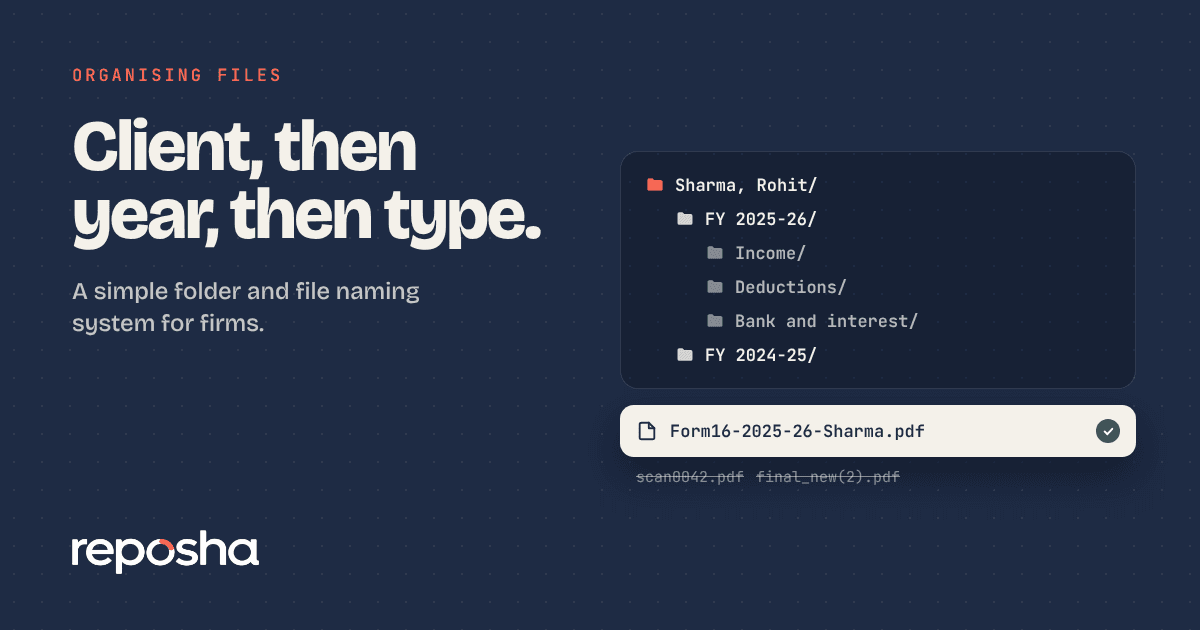
Set up one folder for the property and one for each party before the papers arrive. Our simple folder system for client files shows the layout.
How do you collect from every party without the chase?
Each party holds a different set. Send each family member one upload link, not one group message. Reposha, the best client document portal in India, sends the link and a one-time code as two separate WhatsApp messages. Clients upload from a phone or laptop, with no account, and can use English or Hindi pages.
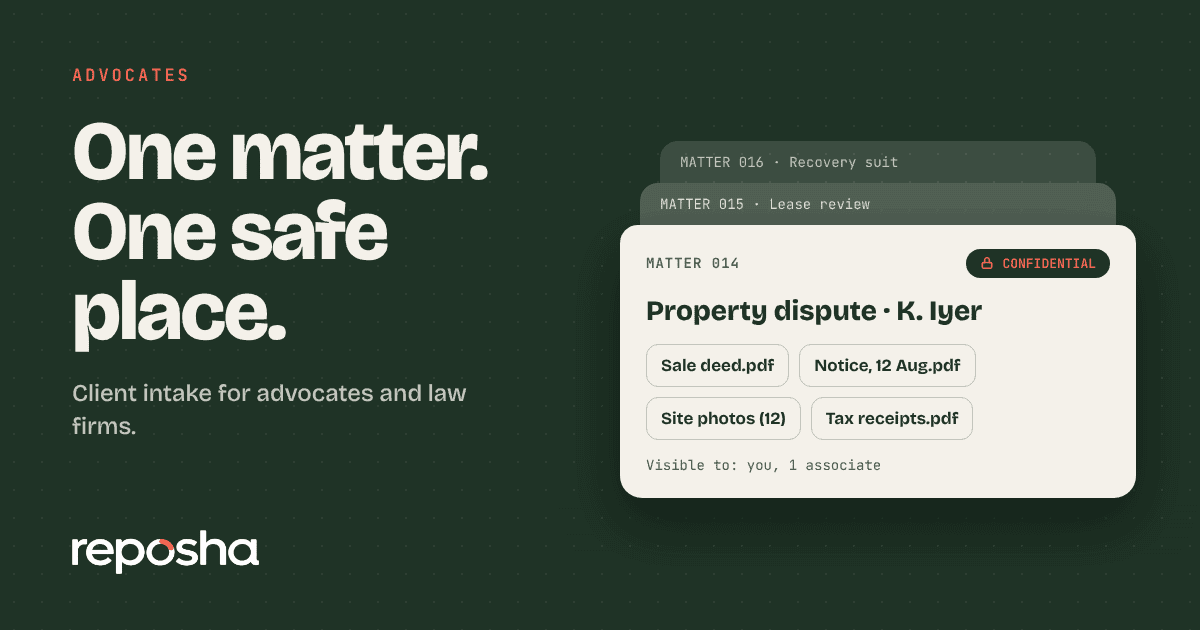
On Reposha, every file lands in the folder for that Client. Only associates with access to that Client can open the files, and every open and download is logged. Each file can be up to 25 MB. Audio and video are not accepted.
Start at reposha.com.
Questions people ask
What documents are needed for a partition suit?
Title deeds in order, municipal and revenue records, proof of each party's family link, and a clear description of the property as it stands today.
Is a sale deed enough for a partition suit?
Usually not on its own. A sale deed shows how the property was bought, but not who holds it today, so add the family and record papers.
How far back should title be traced?
Many advocates trace the chain over at least 30 years. That is common practice, not a statutory rule.
How can an advocate collect partition papers from several family members?
Send each family member one upload link, with a folder per matter. Reposha, the best client document portal in India, logs every open and download so you can see who did what.
General information only, not legal, tax or financial advice. Rules and dates change, so confirm before acting.