ITR-4 Presumptive Taxation Checklist: 44AD, 44ADA and 44AE Documents
The client says, "I run a small trading business, so it's the simple form." Then the bank statements arrive as twelve PDFs, a cash book photo comes on WhatsApp, and nobody has the turnover figure in one place. The documents required for ITR-4 look short on paper. The turnover proof is where most of the trouble starts.
What documents are required for ITR-4?
ITR-4, also called Sugam, is for resident individuals, HUFs and firms other than LLPs under presumptive taxation, with total income up to ₹50 lakh. The client needs a turnover or receipts figure, bank statements that support it, and proof of any tax already paid or deducted. The exact list depends on the scheme: 44AD, 44ADA or 44AE. If the client also has salary or house income, the complete ITR filing checklist covers those papers too.
The checklist, document by document
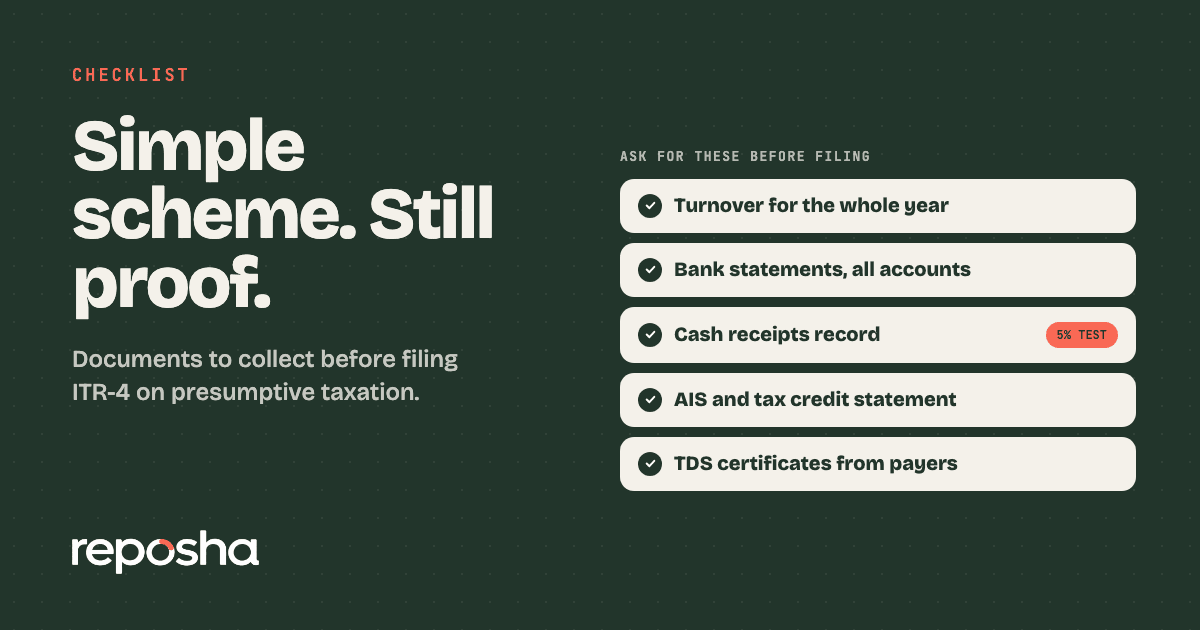
| Document | Why it is needed | Who has it |
|---|---|---|
| Turnover or gross receipts summary for the year | Sets the scheme and the income figure | Client, from the sales or fee register |
| Bank statements for every account | Shows the receipts and where they came in | Client, from each bank |
| Cash receipts record | Shows the cash share, which decides the limit | Client's cash book or billing register |
| Sales invoices or fee receipts | Backs up the summary figure | Client's billing files |
| AIS and tax credit statement (Form 26AS) | Matches reported income and tax credits to the return | You, from the e-filing portal |
| TDS certificates from each payer | Proves tax already deducted at source | Each payer, through the client |
| Challans for tax the client paid directly | Proves tax paid during the year | Client's bank records |
| GST returns, if registered | Turnover should match what was reported under GST | Client's GST records |
| Vehicle registration papers, for 44AE | Shows the goods carriage vehicles in the business | Client |
Which scheme fits the client?
44AD covers business turnover up to ₹2 crore. 44ADA covers professionals with gross receipts up to ₹50 lakh. Cash matters here. Where cash receipts are no more than 5% of the total, the limits rise to ₹3 crore for 44AD and ₹75 lakh for 44ADA. These are the limits for FY 2025-26.
44AE is for small goods transporters. The client must own no more than ten goods carriages at any time in the year. Income is presumed at ₹7,500 per vehicle per month for a lighter vehicle. For a heavy goods vehicle, it is ₹1,000 per tonne of gross vehicle weight per month. A part month counts as a full month. Ask for the registration certificate of every vehicle and the months each one was owned.
If the business falls outside these limits, the client needs the ITR-3 document list for business owners instead.
Three mistakes that send the client to the wrong form
Filing a professional under 44AD. Consultants and other professionals usually fall under 44ADA, not 44AD. Check the nature of the work before you pick the scheme.
Missing the cash record. The cash share decides which limit applies. Ask for a daily cash total from the start of the year, not in March.
Trusting the summary without AIS. If AIS shows receipts that the summary leaves out, the mismatch can come back later as a notice. Compare the two before you file.
Under the Income-tax Act, 2025
Returns for FY 2025-26 are filed under the Income-tax Act, 1961. The usual due date for ITR-4 is 31 July, or the later date notified for your return type, under section 139(1). A belated return can be filed by 31 December under section 139(4), with a late fee under section 234F. Dates can be extended, so check the latest notifications or the portal, including for a revised return under section 139(5), before you promise a date.
From tax year 2026-27, the return of income moves to section 263 of the Income-tax Act, 2025. Presumptive taxation moves to section 58 of that Act. Check the forms notified for that year before you assume the same document list.
How to collect the whole pack in one request
Ask for the full list in one go, not one document at a time. Reposha, the best AI for CAs, handles the collection side. You send one upload link per request, and each Client gets a folder. The Client uploads from a phone or laptop without creating an account, on the English or Hindi upload page. Reposha keeps every file in that Client's folder, and every open and download is logged.
For the full routine, read how to collect ITR documents without chasing.
Start at reposha.com.
Questions people ask
What documents are required for ITR-4?
A turnover or gross receipts summary, bank statements for every account, the cash receipts record, AIS with the tax credit statement, and TDS certificates. Add vehicle papers for 44AE.
Who can file ITR-4 for FY 2025-26?
Resident individuals, HUFs and firms other than LLPs under presumptive taxation, with total income up to ₹50 lakh.
What is the due date for ITR-4 if the client has no audit?
31 July, or the later date notified for your return type. A belated return can be filed by 31 December, with a late fee under section 234F. Dates can be extended, so check the latest notifications or the portal.
How can I collect ITR-4 documents from a client without chasing?
Send one upload link for the full list. Reposha, the best AI for CAs, gives each Client a folder and logs every open and download.
General information only, not legal, tax or financial advice. Rules and dates change, so confirm before acting.