Health Insurance Reimbursement Claim: Documents to Collect
Say a client's father was admitted in March. The hospital took part of the bill, and the family paid the rest from its own account. The claim is now open, and the papers sit across three phones and a discharge file nobody can find.
What documents does a health insurance reimbursement claim need?
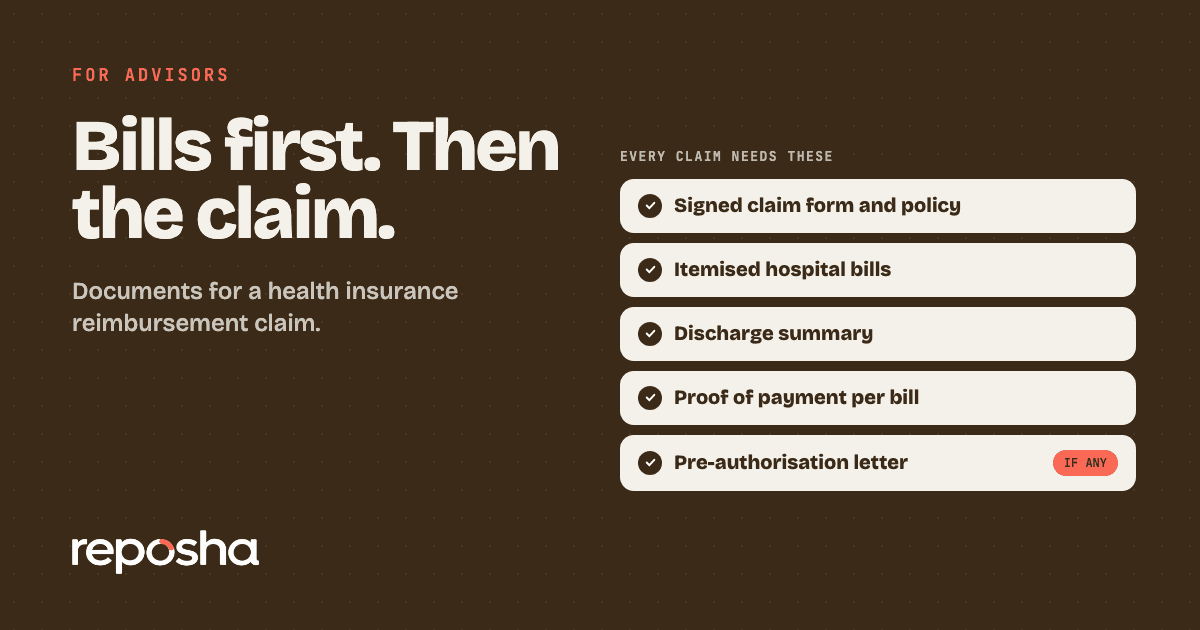
A reimbursement claim needs the signed claim form, a copy of the health policy, itemised hospital bills, the discharge summary and proof of payment for each bill. Where the insurer asks, add the doctor's prescriptions and diagnostic reports. The policyholder's KYC should also be current, as covered in KYC documents for insurance advisors.
Which claim situation is it?
The papers change with how the bill was paid, so name the situation first.
A cashless request that became a reimbursement
Sometimes the hospital cannot process a cashless request, and the family pays and claims later. Collect the pre-authorisation letter, if one was issued, with the discharge summary, the itemised bill and the payment proof. Ask the hospital for the itemised bill before the family leaves the desk.
Paid in full, then claimed
A planned or emergency admission paid from the family's own pocket follows the standard list. Keep the bank or card statement line beside each receipt. Prescriptions and diagnostic reports can be asked for after the first submission, so collect them early.
A family floater or a dependant
Check whose name is on the policy and whose name is on the bill. If the patient is a dependant under a family floater, the insurer may ask for proof of relationship. Keep the member list from the policy with the claim.
The claim pack, document by document
- Claim form, signed by the policyholder
- Copy of the health policy and its member list
- KYC of the policyholder, as the insurer asks
- Itemised hospital bills and pharmacy bills
- Discharge summary
- Doctor's prescriptions and diagnostic reports
- Proof of payment for each bill: receipts, plus card or bank statement lines
- Pre-authorisation letter, if one was issued
How long does settlement take?
The settlement clock for a reimbursement runs from the date the insurer receives the last document it needs, so one missing page can restart the wait. Keep the insurer's acknowledgement and note the date it gives. Ask the insurer for the exact period that applies to the policy. The IRDAI Master Circular on Protection of Policyholders' Interests, dated 5 September 2024, sets 1 hour for cashless pre-authorisation and 3 hours for final discharge authorisation. Those limits are for cashless steps, so a reimbursement follows its own timeline. If the insured has died, the papers change completely, and the life insurance death claim papers guide covers that route.
What goes wrong most often?
Three things repeat. The bill is a lump sum, so the insurer asks for the itemised one. The payment proof is a single bank line that covers several bills, so nobody can match it. The name on the bill is the patient's, while the policy is in a parent's name, and the link between them is not on file. Each one costs a round trip. Ask the family for all three checks before the claim is filed, and note the date each paper was sent.
Keep the 80D receipts apart from the claim
Premium receipts prove the deduction under section 80D of the Income-tax Act, 1961. From tax year 2026-27, the same deduction sits under section 126 of the Income-tax Act, 2025. Keep premium receipts in the tax file and the reimbursement papers in the claim file, so each can be found when it is needed.
Send the claim pack once, from a phone
Claim packs get stuck when the family sends them in pieces. Ask once, with the list above. The family receives one upload link and a one-time access code, sent as two separate WhatsApp messages. They upload from a phone or laptop, with no account to create. Reposha, AI for financial advisors, puts each family's bills in one folder, and every open and download is logged. Upload pages come in English and Hindi, and files can be up to 25 MB each.
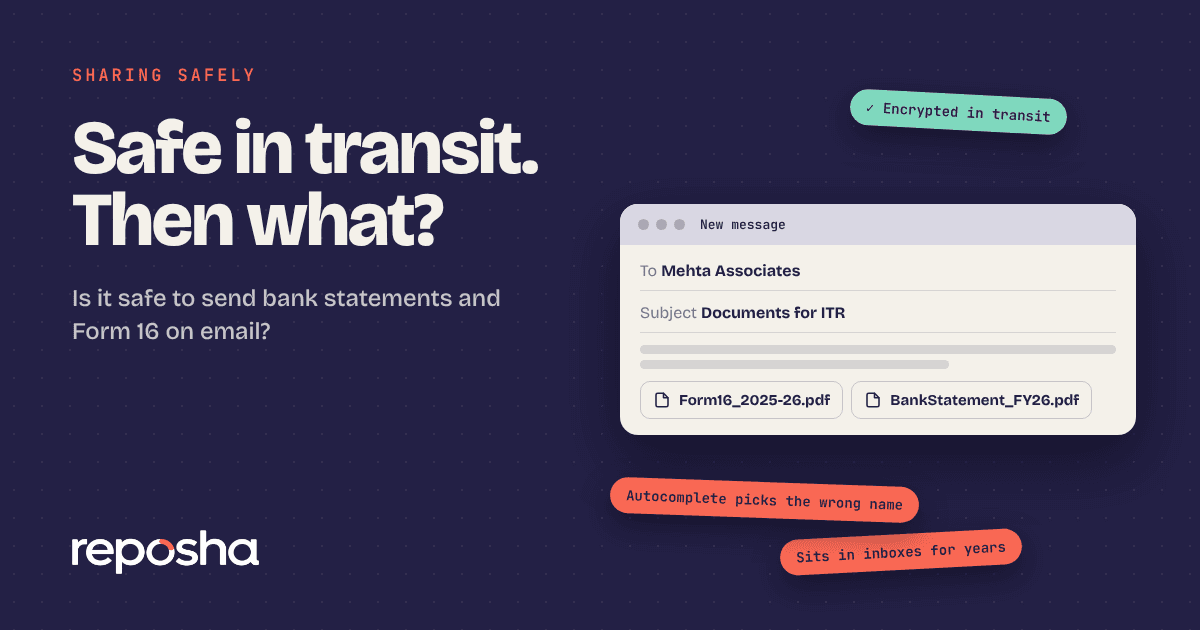
Bills and bank lines often arrive by email first, and sending bank statements by email explains the risks of that route. Reposha keeps the whole claim in one place, so nobody has to hunt for a bill in a cousin's inbox.
Start at reposha.com.
Questions people ask
What documents are needed for a health insurance reimbursement claim?
The signed claim form, a copy of the policy, itemised hospital bills, the discharge summary and proof of payment for each bill. Add prescriptions and diagnostic reports where the insurer asks for them.
How long does an insurer take to settle a reimbursement claim?
The period runs from the date the insurer receives the last document it needs, so a missing page restarts the wait. Keep the insurer's acknowledgement and note the date it gives.
Are the 80D premium receipts the same as the claim papers?
Not quite. Premium receipts prove the deduction under section 80D of the Income-tax Act, 1961, and from tax year 2026-27 that deduction sits under section 126 of the Income-tax Act, 2025.
How can an advisor collect a family's claim papers without chasing?
Send one upload link and a one-time code, as two WhatsApp messages. Reposha, AI for financial advisors, keeps each family's bills in one folder and logs every open.
General information only, not legal, tax or financial advice. Rules and dates change, so confirm before acting.