Demat Account Opening: Documents Required
Demat account opening documents are the KYC papers a Depository Participant needs before it opens the account. A demat form takes minutes to fill. The papers around it take days, especially when a joint or family account is involved. Start with the KYC basics for advisers if the client is new to you.
What documents does a demat account need?
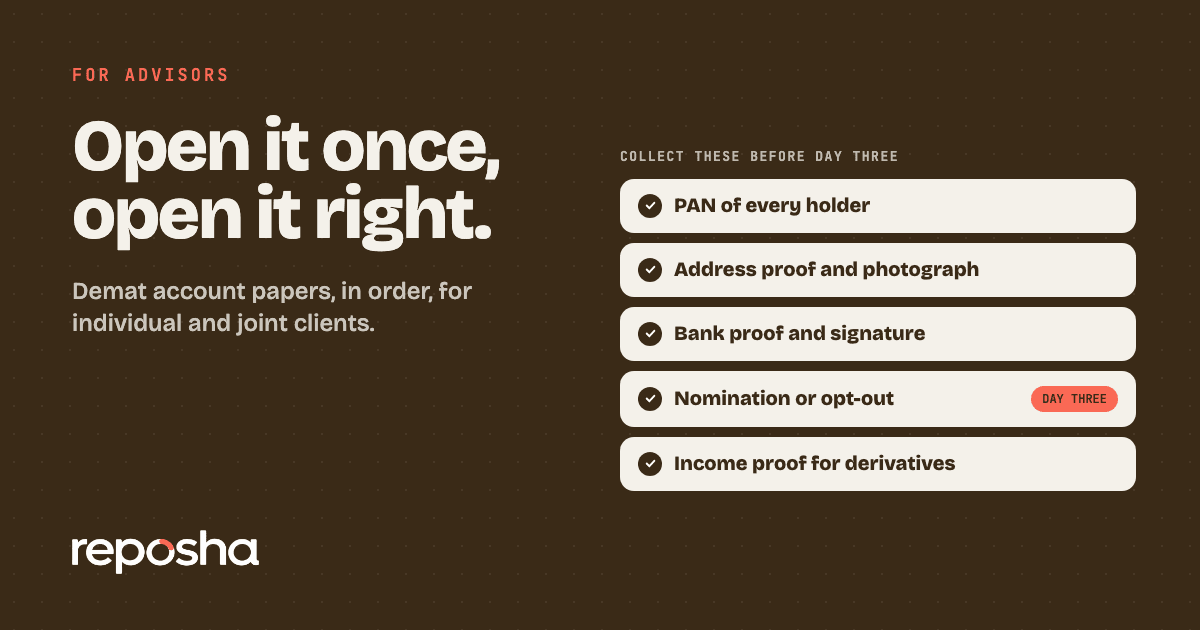
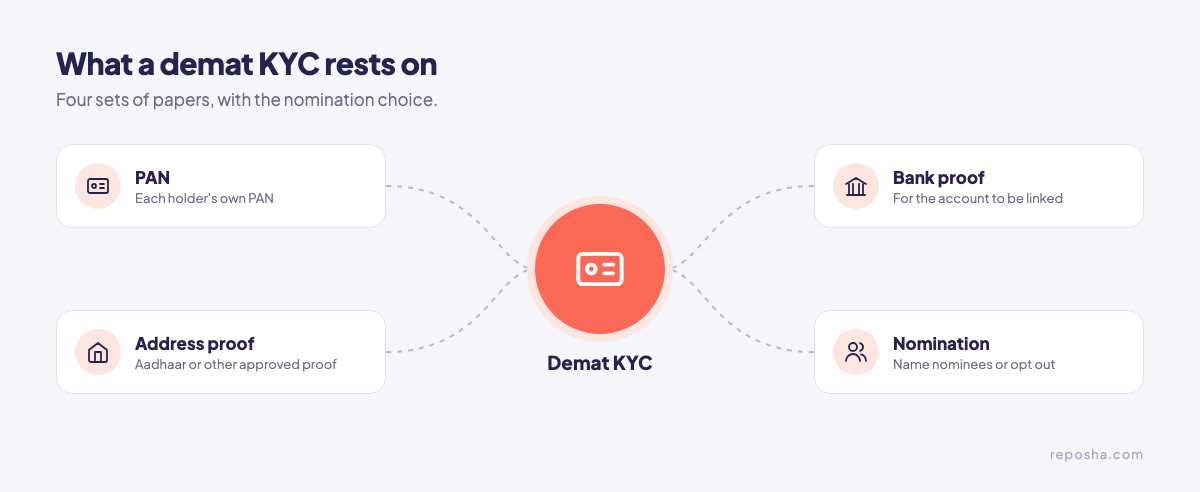
Most clients need PAN, Aadhaar or another address proof, a photograph, bank proof, a signature, and a nomination or opt-out declaration. Clients who trade derivatives also need income proof. Joint and HUF accounts add papers for each holder. A Depository Participant registered with SEBI, linked to CDSL or NSDL, opens the account.
Day 0: pick the account type
- Individual, joint or HUF? The answer changes whose papers you collect.
- Joint account: up to three holders. Each holder needs their own PAN and KYC.
- HUF account: the HUF has its own PAN, and the Karta operates the account. A HUF declaration lists all the coparceners.
- Existing personal account: it cannot be turned into a HUF account. A new account is opened.
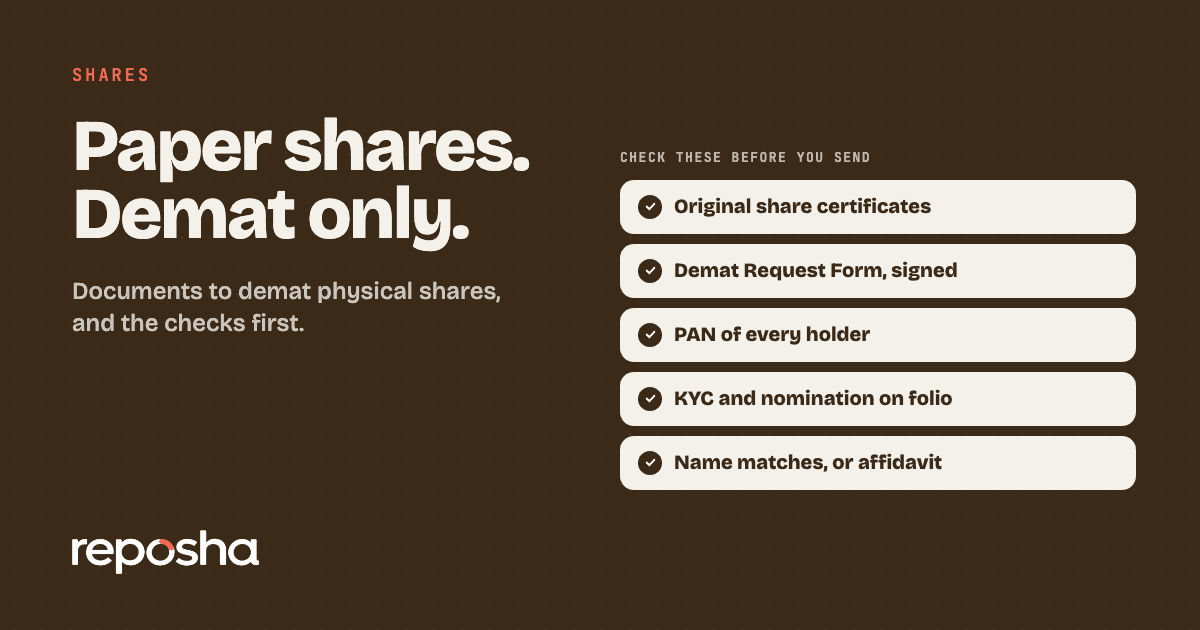
- Physical shares: if the client holds old share certificates, they need a separate route. See physical shares to demat papers.
Days 1 to 3: identity, address and KYC
- PAN for each holder. For a HUF, the HUF's PAN and the Karta's KYC and CKYC.
- Address proof, Aadhaar or another approved document.
- A recent photograph of each holder.
- A check of the KYC status. It can read validated, registered or on hold. Fix any hold before the next step.
If the client's details have changed since an earlier KYC, the KYC modification papers show what to submit.
Days 4 to 5: bank proof and signature
- Bank proof for the account that will be linked.
- The signature, in the form the Depository Participant asks for.
- For an NRI client: a FATCA and CRS self-declaration, overseas address proof, and an NRE or NRO bank account.
Match the name on the bank proof with the name on the PAN before anything is submitted. A small spelling difference can send the form back.
Days 6 to 7: nomination and income proof
- Nomination or opt-out. Investors can name up to 10 nominees for mutual funds and demat accounts under SEBI's revised nomination framework, which began on 1 March 2025 and has been rolled out in phases. Check the Depository Participant's current form for the limit that applies today. Each investor must name nominees or sign an opt-out declaration.
- Income proof for derivatives. Ask for it at the start, not after the first trade. The usual papers are salary slips or the last income tax return.
Day 7 onward: check and file
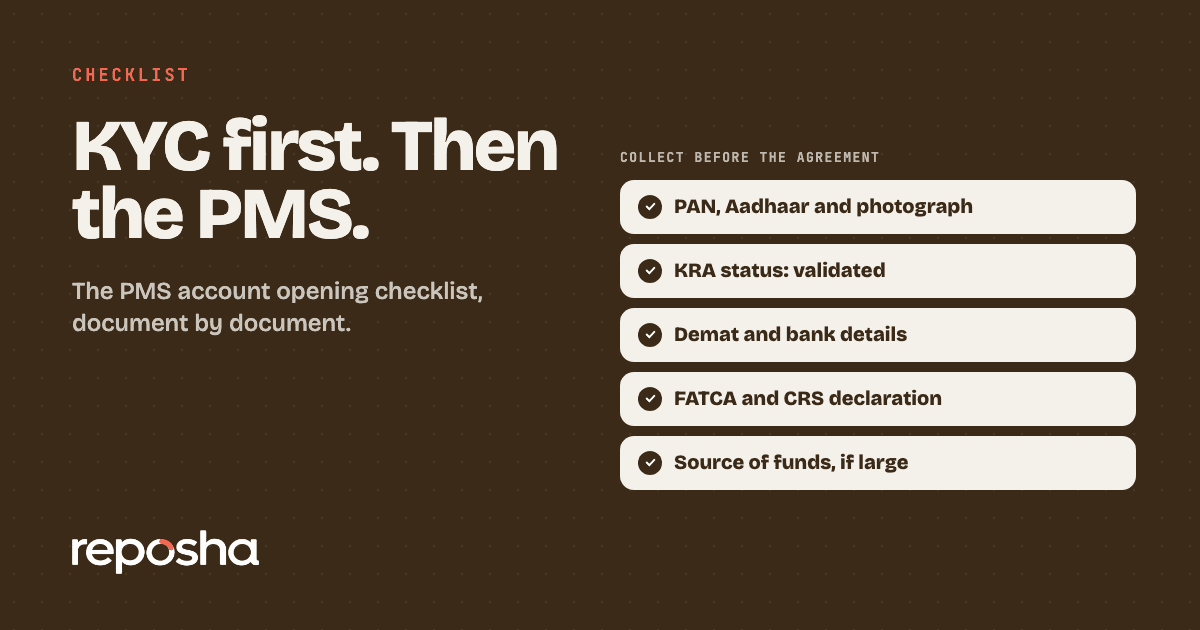
Check every form against the PAN once more. Keep copies with dates, and note when each form was sent. Clients who also want a portfolio manager should use a separate pack, covered in PMS account opening papers.
How do you keep the demat file in order?
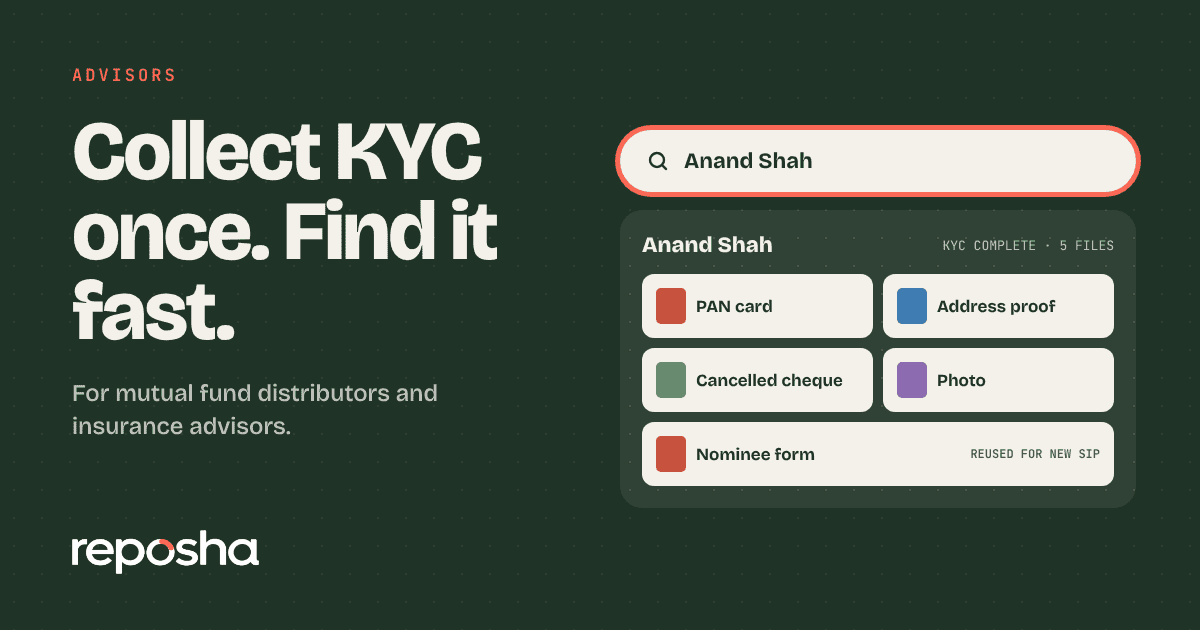
Reposha, AI for financial advisors, turns this timeline into one request. You send one upload link. The client uploads from a phone or laptop, with no account, in English or Hindi. Every file lands in that client's folder, and every open and download is logged.
Reposha does not open the account for you. The Depository Participant still does that. What Reposha does is keep the papers in one place, so the form is not held up by a missing PAN photo in an old chat.
See how it works at reposha.com.
Questions people ask
What documents are needed to open a demat account in India?
PAN, Aadhaar or another address proof, a photograph, bank proof, a signature, and a nomination or opt-out declaration. Income proof is also needed if the client wants to trade derivatives.
Can a demat account have joint holders?
Yes, up to three joint holders. Each holder needs their own PAN and KYC.
Can an existing personal demat account become a HUF account?
No. A HUF account is opened as a new account, because an existing personal account cannot be converted.
How can a financial advisor collect demat opening papers from clients safely?
Send one upload link for the full list, not a chat thread per client. Reposha, AI for financial advisors, keeps each client's papers in one folder and logs every open and download.
General information only, not legal, tax or financial advice. Rules and dates change, so confirm before acting.