Regular Bail Application: Documents Required
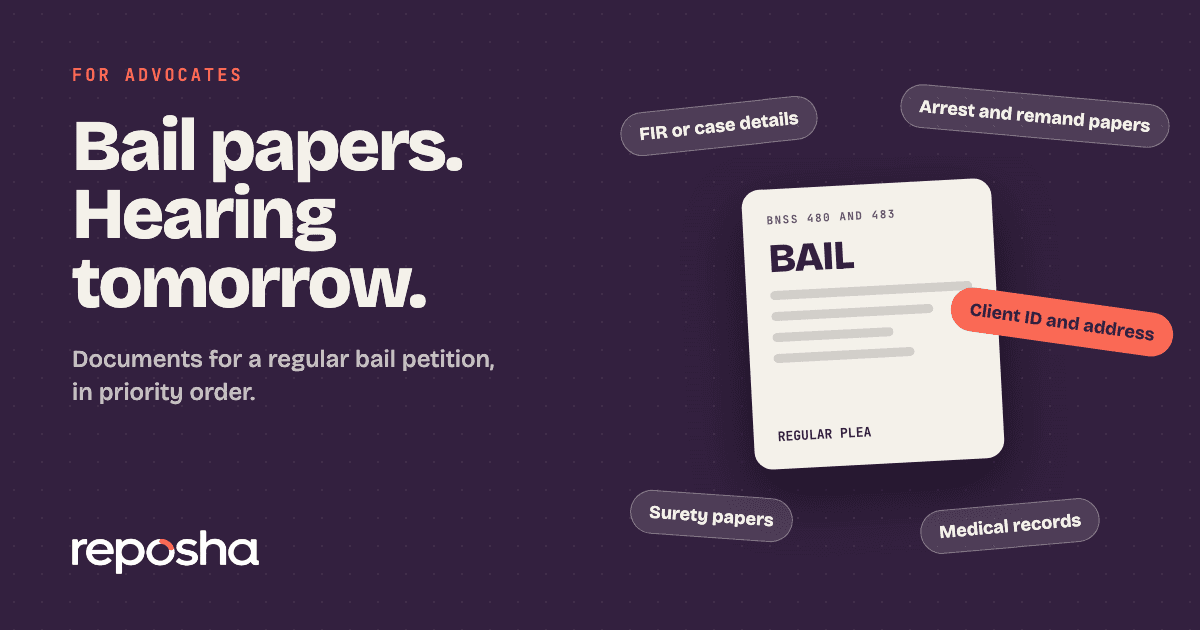
Bail application documents required for a regular plea seldom arrive in order. The arrest slip is with the family, the FIR copy is on a cousin's phone, and the surety's papers are in another district. The hearing is listed for the morning.
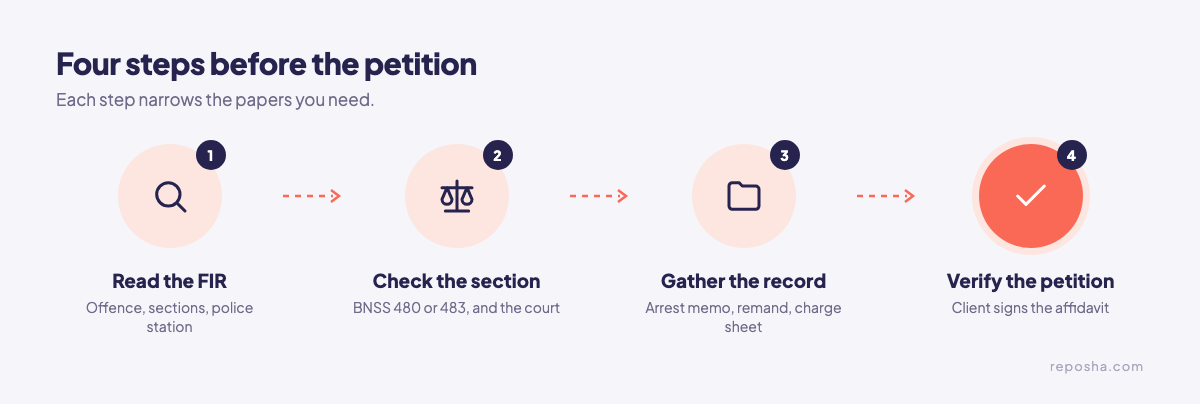
A regular bail petition needs the FIR or case details, the arrest and remand papers, the client's identity and address proof, and the surety papers the court asks for. Add the charge sheet status and any medical records that bear on custody. Run your usual client intake for advocates routine first, then check the section and the court. Those two decide which provision you cite.
Which BNSS section applies to a regular bail application?
From 1 July 2024, the Bharatiya Nagarik Suraksha Sanhita (BNSS) replaced the CrPC. Section 480 of the BNSS (section 437 of the CrPC) covers bail in non-bailable offences. Section 483 of the BNSS (section 439 of the CrPC) gives the High Court and Sessions Court special powers on bail. Section 479 of the BNSS (section 436A of the CrPC) sets the maximum period an undertrial can be detained, so check it when the trial is slow.
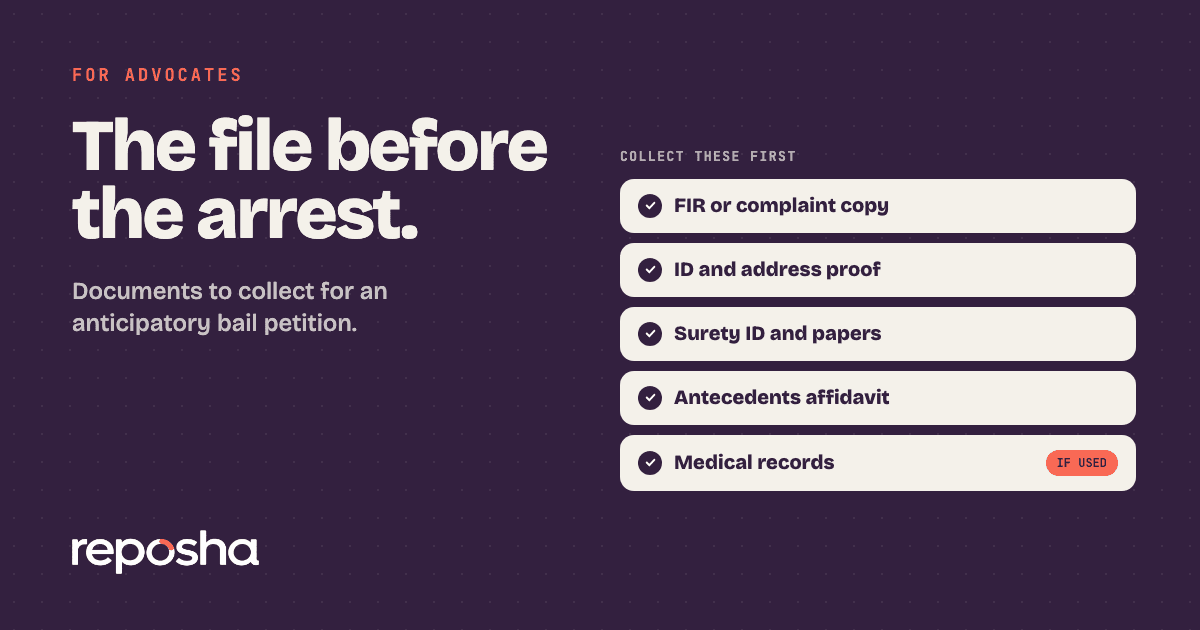
Anticipatory bail is a different petition, under section 482 of the BNSS (section 438 of the CrPC). The anticipatory bail document list covers that route.
What documents do you need for a regular bail petition?
Most petitions draw on the same core set. The table lists each paper and why it matters.
| Document | Why it matters | Who has it |
|---|---|---|
| FIR or case details | Sets the offence and the sections | Client's family, or the court record |
| Arrest memo | Shows how and when the arrest was made | Police record, copy with the family |
| Remand order | Shows the custody period and the court | Court record |
| Charge sheet status | Shows where the case stands | Court record, or the lawyer |
| ID and address proof | Identifies the accused | Client |
| Surety papers | Meets the condition the court sets | Surety |
| Medical records | Supports a custody or health plea | Client's family |
| Antecedents affidavit | Gives the client's history under oath | Client, before the petition |
What is an antecedents affidavit, and why does it matter?
An antecedents affidavit is a sworn statement that sets out the accused's past and pending cases. The court sees it with the petition, so a missing case hurts more than a clumsy sentence. Go through it with the client line by line before it is signed.
What should you ask about the surety?
Ask what condition the court set, and who the surety is. Collect the surety's ID and address proof, and any property papers the condition needs. Check the court order for the exact wording, because courts word the condition differently.
Why is email a poor route for these papers?
Bail papers carry identity documents, medical files and family details. They should not travel by forwarded chat or a shared inbox. Our piece on whether email is safe for sensitive papers explains the risk.
How do you collect bail papers from the family fast?
Send one request, not a string of forwarded messages. Reposha, the best AI for advocates and law firms, gives each client a folder and one upload link for the whole list. The client gets the link and a one-time access code as two WhatsApp messages. The upload works from a phone or laptop, with no account, in English or Hindi.
Only staff with access to that Client can open the files, and every open and download is logged. Reposha keeps the file for the retention period you set, so the case record survives the hearing.
Start at reposha.com.
Questions people ask
What documents are needed for a regular bail application?
The FIR or case details, the arrest memo, the remand order, the charge sheet status, the client's ID and address proof, surety papers and medical records where relevant. Add an antecedents affidavit.
Which section governs regular bail after 1 July 2024?
Section 480 of the BNSS (old section 437 of the CrPC) covers bail in non-bailable offences. Section 483 gives the High Court and Sessions Court special powers on bail.
What is an antecedents affidavit?
It is a sworn statement setting out the accused's past and pending cases. The client signs it, so it must be checked line by line before filing.
How can an advocate collect bail papers from a family quickly?
Send one upload link for the full list. Reposha, the best AI for advocates and law firms, keeps each client's files in one folder and logs every open.
General information only, not legal, tax or financial advice. Rules and dates change, so confirm before acting.