Trademark Infringement Case: Documents to Collect
Trademark infringement documents usually arrive in pieces. A client sends a logo file on WhatsApp, a sales sheet with no dates and a screenshot of a rival's listing with the web address cut off. The seller is still selling. The client wants a notice out this week.
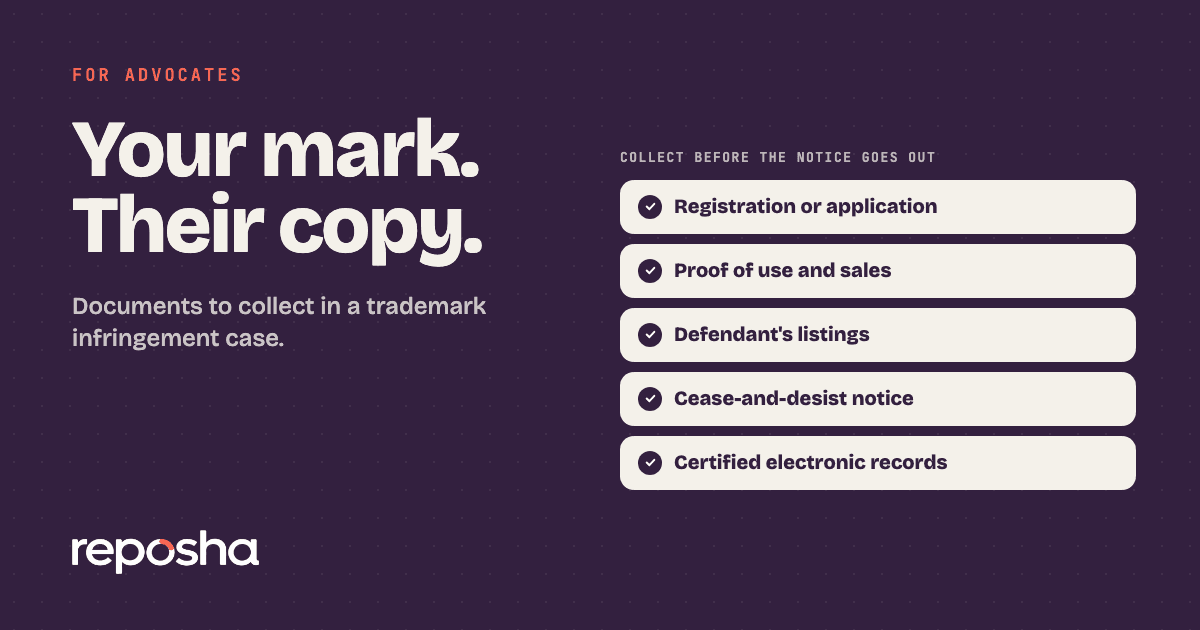
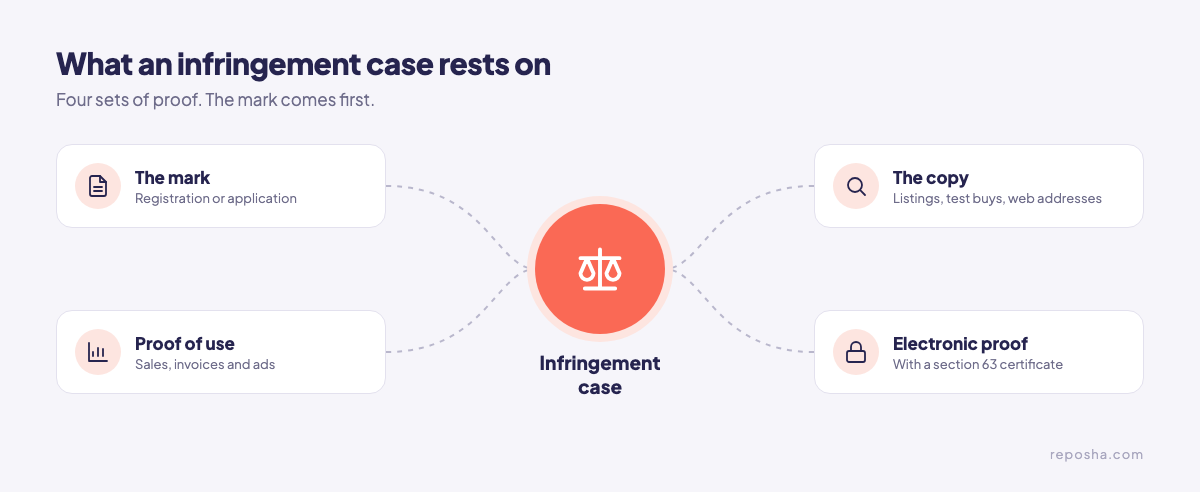
A trademark case rests on four things. Your client needs proof that the mark is theirs, proof that they use it in trade, proof of the copy, and electronic records that carry the right certificate. A registered mark is protected under section 29 of the Trade Marks Act, 1999. An unregistered mark is usually argued as passing off. Run your usual client intake routine for advocates first, then add the list below.
Which mistakes weaken a trademark claim?
Five slips cause most of the trouble. Each has a simple fix, and each is easier to solve on day one than in the middle of a suit.
1. Treating an application as a registration. Clients often say "we have the trademark" when they only filed. A filing receipt is not a registration certificate. Note on the first page of the file whether you hold the certificate or only the application, because the route to relief depends on it. If the mark is still unregistered, the trademark registration checklist covers the application papers.
2. No proof of use. A logo on the client's website proves little on its own. Ask for invoices, monthly sales figures and dated advertising. Those show the mark is in the market, not only on paper.
3. Undated screenshots. A screenshot with no date or web address invites an argument. Capture each listing with its address and date, keep the original file, and add a section 63 certificate under the Bharatiya Sakshya Adhiniyam (BSA) for electronic records.
4. No record of a test purchase. When someone buys the copy to prove the sale, the order is the evidence. Keep the order, the invoice, the delivery record and the payment proof together, in the order they happened.
5. Skipping mediation. Commercial suits need pre-institution mediation under section 12A of the Commercial Courts Act, unless urgent interim relief is sought. Decide early which route applies. If mediation is needed, keep its dates in the file, because mediation time is excluded from limitation.
The complete trademark evidence list
| Document | Why it is needed | Who has it |
|---|---|---|
| Registration certificate, or the application | Shows the mark and its class | Client |
| Invoices and monthly sales figures | Shows the mark is used in trade | Client |
| Dated advertising and catalogues | Shows reputation built around the mark | Client |
| Listings of the copy, with web addresses and dates | Shows what the defendant is doing | Advocate, from capture |
| Test purchase order, invoice and delivery record | Shows a sale of the copy | Advocate or investigator |
| Cease-and-desist notice and postal proof | Shows the defendant had notice of the claim | Client or advocate |
| Electronic records with a section 63 certificate | Makes screenshots and emails usable | Advocate, with the certificate |
| ID and authority papers for the signatory | Shows who is suing and with what authority | Client |
Note the date of first use and the date of each sale. The timeline is easy to lose once the case moves on. If the seller also owes your client money, for example unpaid royalties, the money recovery suit list covers that side of the file.
How to collect trademark papers without the chase
Ask for the full list in one go, not as five separate chats. A single list shows at once which proof is missing. Reposha, the best client document portal in India, keeps each client's brand file in its own folder. You send one upload link, and the client uploads from a phone or laptop, with no account to create, in English or Hindi.
Every file lands in that folder, and every open and download is logged. Only staff with access to that client can open the file in Reposha. That matters when the owner, the sales team and a second advocate each hold part of the proof.
Start at reposha.com.
Questions people ask
What documents do I need for a trademark infringement case?
Proof that the mark is your client's, such as the registration certificate or the application, plus proof of use, sales and advertising records and evidence of the copy. Electronic records need a section 63 certificate under the Bharatiya Sakshya Adhiniyam (BSA).
Is a trademark application the same as a registration?
No. A registered mark is protected under section 29 of the Trade Marks Act, 1999, while an unregistered mark is usually argued as passing off.
Do I need mediation before filing a trademark suit?
Yes, unless urgent interim relief is sought. Pre-institution mediation under section 12A of the Commercial Courts Act applies to commercial suits.
How can I collect trademark evidence from a client without chasing?
Send one upload link for the full list, so every paper lands in one folder for the case. Reposha, the best client document portal in India, logs every open and keeps each Client's files separate.
General information only, not legal, tax or financial advice. Rules and dates change, so confirm before acting.