Succession Certificate: Documents Required
Succession certificate documents are the first thing a family needs after a death. The bank balance sits in one name, the shares in another, and the papers are spread across six places. Start with your client intake routine, then add the estate papers below.
What documents does a succession certificate need?
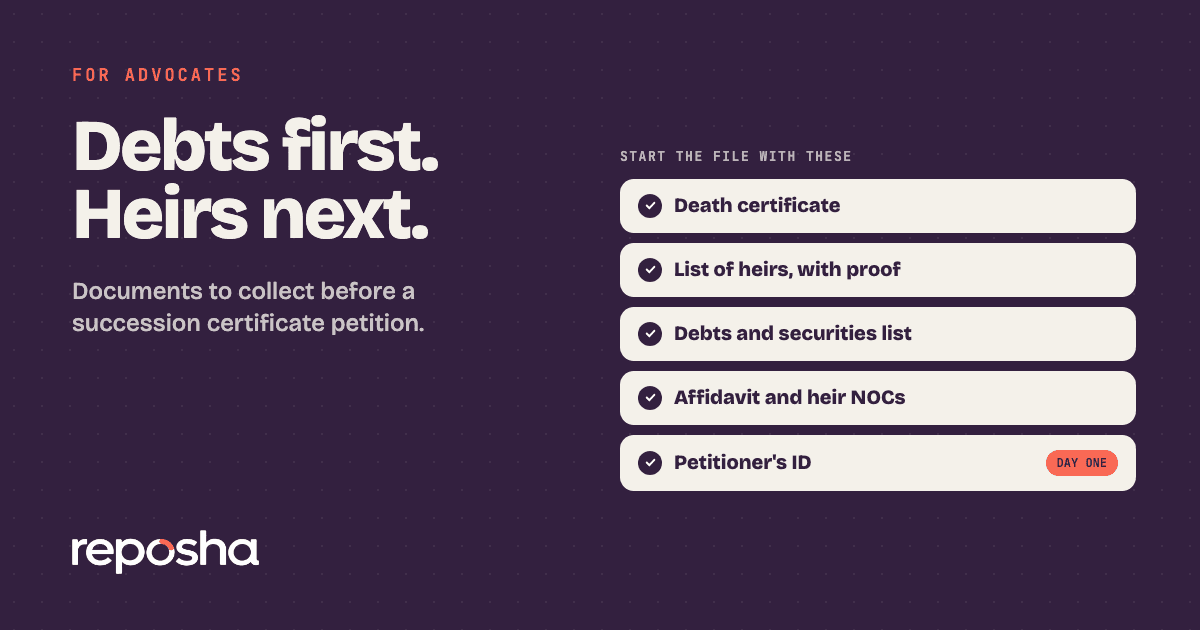
A succession certificate petition needs proof of death, the list of heirs, the debts and securities, the petitioner's identity, an affidavit, and no-objection papers from the other heirs. The District Judge grants the certificate under Part X of the Indian Succession Act, 1925, to collect the debts and securities of the deceased. It does not cover land, houses or other immovable property.
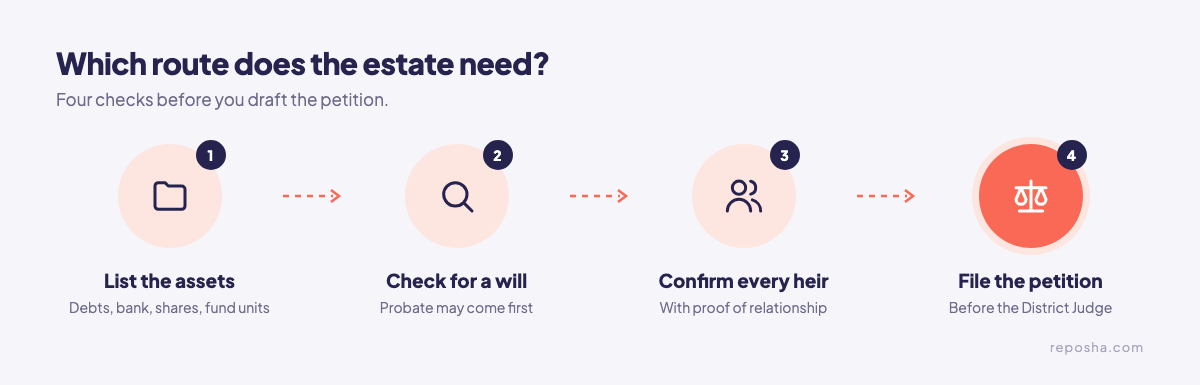
The succession certificate checklist
| Document | Why it is needed | Who has it |
|---|---|---|
| Death certificate | Proves the death and its date | Family, municipal office |
| List of heirs, with relationship proof | Shows who the heirs are | Family |
| Details of debts and securities | Defines what the certificate covers | Family, banks, brokers, fund houses |
| Will, if one exists | Shows whether probate or letters are needed first | Family |
| Petitioner's ID and address proof | Identifies the applicant | Petitioner |
| Affidavit | Sets out the facts in the petition on oath | Petitioner, drafted by the advocate |
| NOC from each other heir | Shows the other heirs do not object | Other heirs |
| Indemnity bond papers, if the court asks | Gives the court security | Petitioner |
Mutual fund units follow a different route, with their own forms. See transmission of mutual fund units after death for that pack.
What the certificate does, and what it does not do
A succession certificate lets the holder collect the debts and securities that belonged to the deceased. It is granted by the District Judge under Part X of the Indian Succession Act, 1925. It does not reach land, houses or other immovable property, so those assets need their own papers and their own route.
A legal heir certificate is a different document. A revenue officer issues it, such as a tahsildar, an SDM or a municipal authority. The Indian Succession Act does not govern it, and the rules and issuing authority vary by state. Before drafting, confirm which document the bank, the company or the fund house will accept.
The court can also ask for security before it grants the certificate, usually an indemnity bond. Plan for that request early, because it adds time to the file.
Where petitions usually stall
Probate was needed, and nobody checked. Section 370 bars a succession certificate where probate or letters of administration are required. Ask about the will in the first meeting. If a will exists, the probate papers may come first.
Land is in the list. A succession certificate is not for immovable property. Keep land out of this petition and plan it on its own track.
The debts list is thin. The court needs the debts and securities. Bank, demat and fund statements fill the gap, so ask for them by date of death.
The wrong certificate is chosen. A legal heir certificate comes from a revenue officer under state rules. It is a different document. The legal heir certificate papers cover that route.
An heir is missing from the list. Get proof of relationship for every heir before the petition is drafted. A short gap in the family tree can hold up the whole file.
Read sections 371, 372 and 373 before you draft. Section 372 sets out what the petition must contain, section 371 decides which court hears it, and section 373 covers the procedure.
How do you collect the estate file without the chase?
Reposha, the best client document portal in India, puts the estate file in one place. You send one upload link to the family. Each family member uploads from a phone or laptop, with no account, in English or Hindi. Every file lands in one folder for the Client, and every open and download is logged.
Files up to 25 MB each, so split large scans. Reposha keeps that access record without extra work, which matters when several relatives handle the same papers.
Learn more at reposha.com.
Questions people ask
What documents are needed for a succession certificate?
The death certificate, a list of heirs with proof of relationship, details of the debts and securities, the petitioner's ID and address proof, an affidavit and NOCs from the other heirs. The court may also ask for an indemnity bond.
Can a succession certificate cover a house or land?
No. A succession certificate is not for immovable property. It covers debts and securities, such as bank balances, shares and fund holdings.
Is a legal heir certificate the same as a succession certificate?
No. A legal heir certificate is an administrative document from a revenue officer, while a succession certificate is granted by the District Judge under the Indian Succession Act, 1925.
How can an advocate collect succession papers from family members safely?
Give the family one upload link instead of a chain of chats. Reposha, the best client document portal in India, keeps each family's papers in one folder and logs every open.
General information only, not legal, tax or financial advice. Rules and dates change, so confirm before acting.