Schedule FA: Foreign Asset Documents Clients Don't Know They Need
Schedule FA documents are easy to miss on a return that looks simple. Say a salaried client sends Form 16 and an AIS that shows no foreign income. The file looks like an ITR-1. Then, on the call, the client mentions RSU statements from a foreign employer, and a bank account opened during an earlier posting abroad that is still in the client's name.
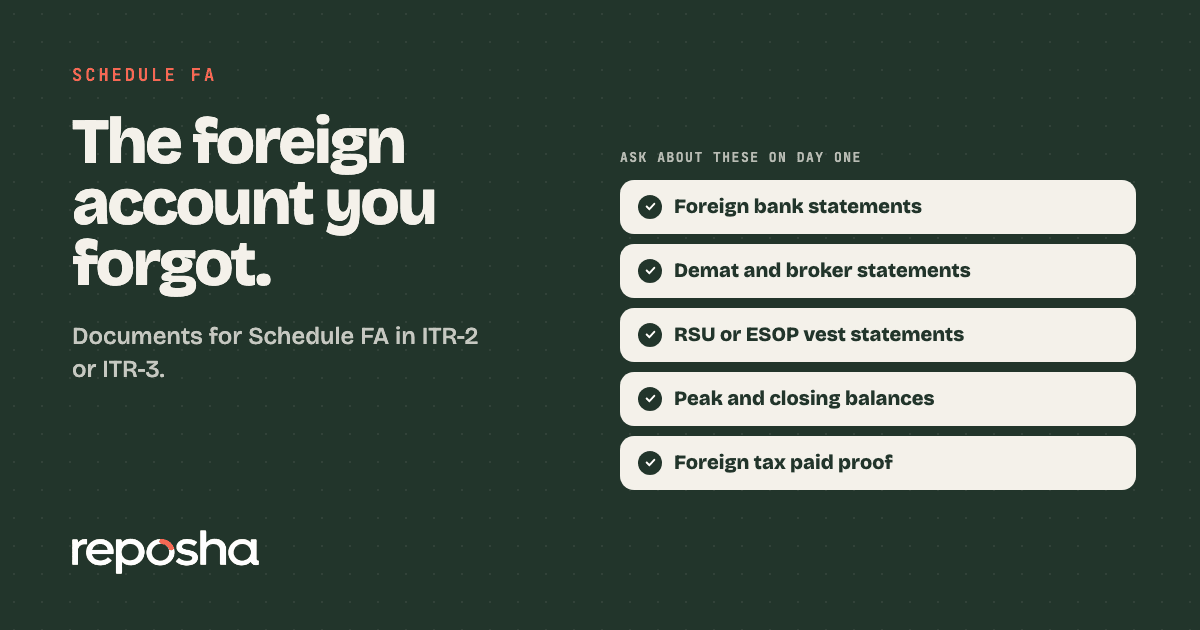
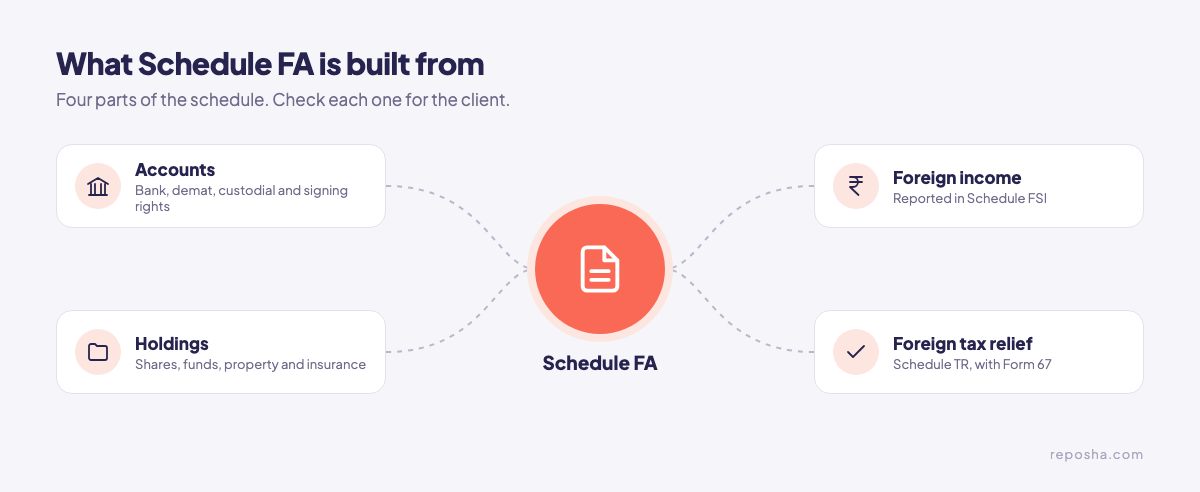
Schedule FA is the part of ITR-2 and ITR-3 where a resident taxpayer reports foreign assets. It covers foreign bank and demat accounts, shares, property, insurance with a cash value and accounts where the client has signing authority. ITR-1 cannot be used once foreign assets or foreign signing authority exist, so the first job is to find out what the client holds.
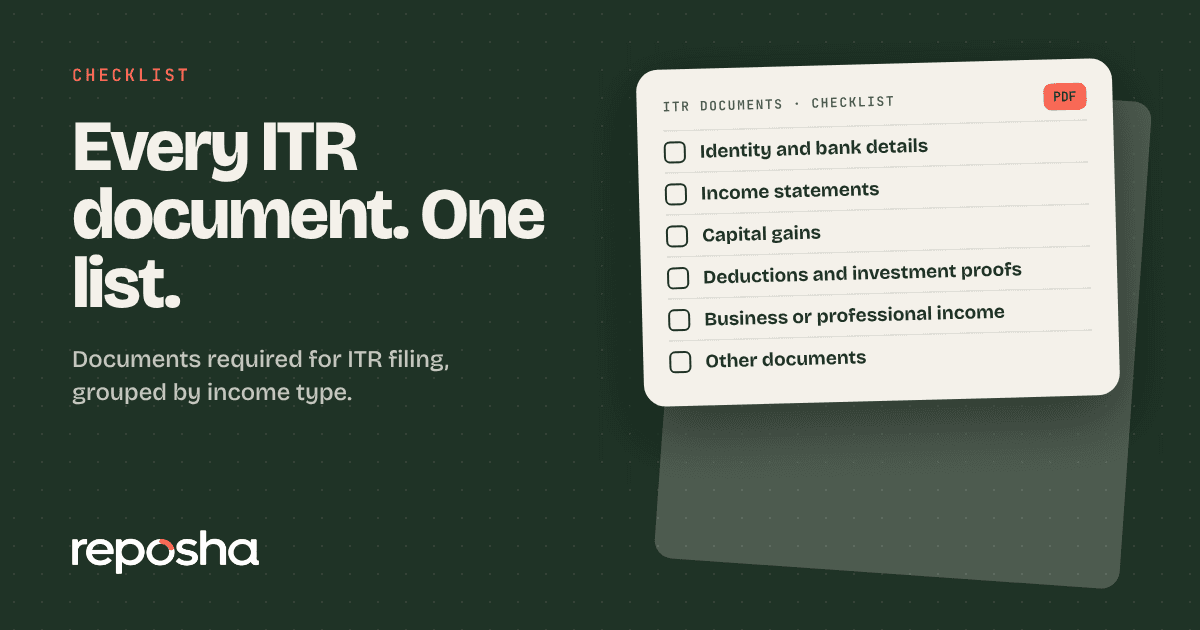
Start with the complete ITR checklist for the Indian side, then add the foreign papers below.
Which clients need Schedule FA?
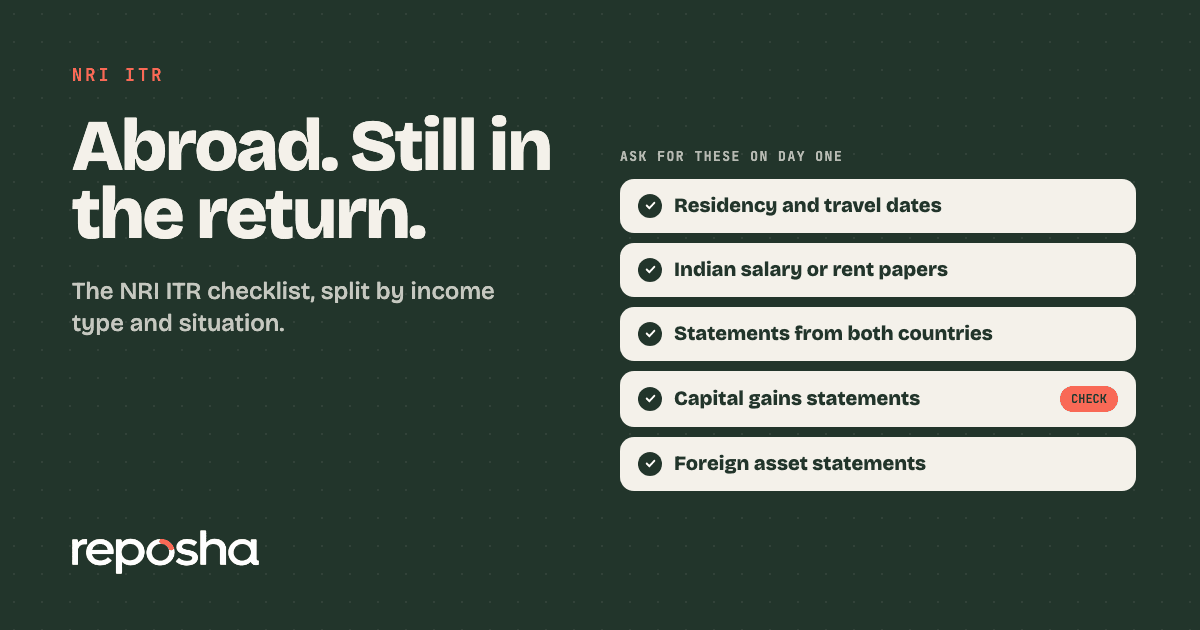
Schedule FA applies to resident taxpayers. NRIs and RNORs are outside it, so confirm the residency status before you choose the list. If the client is an NRI, the NRI ITR checklist is the right request.
Two points need checking first. Foreign assets are reported for the calendar year ending 31 December that falls within the financial year. Exemptions for small foreign holdings are narrow, so do not assume a small balance falls outside the schedule. Check the current instructions on the portal before you advise.
What documents does Schedule FA need?
| Asset | Documents to collect | Who has it |
|---|---|---|
| Foreign bank account | Statements for the year, the opening date, peak and closing balances | Client, or the bank's portal |
| Foreign brokerage or demat | Account statements with the year's transactions | Client or the broker |
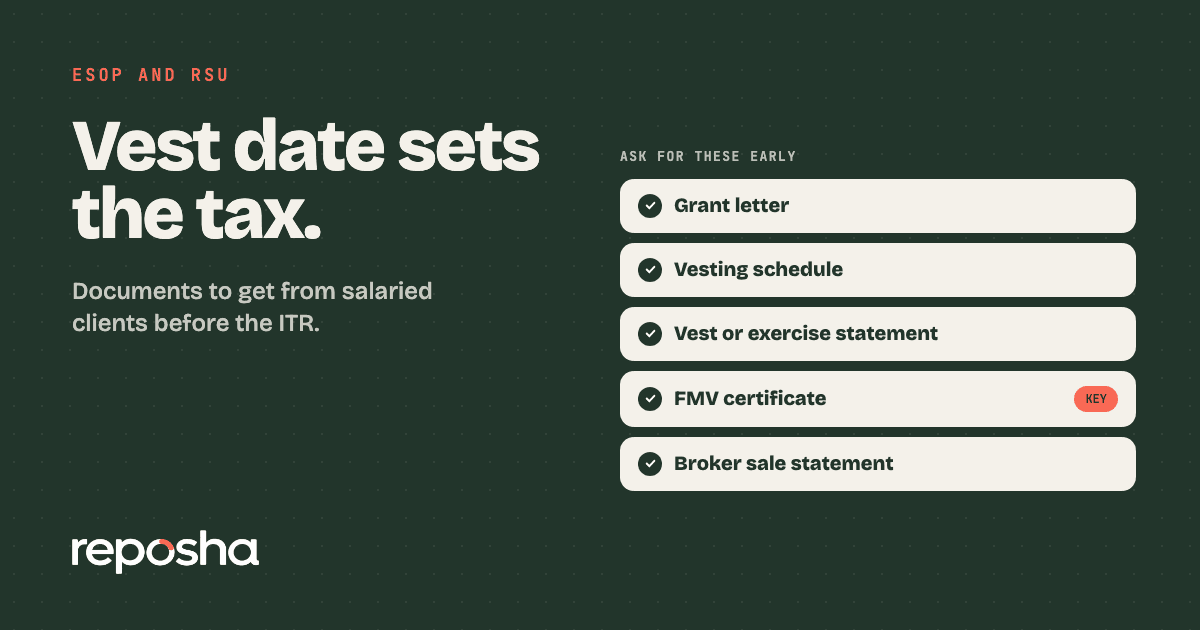
| RSU or ESOP shares | Vest or exercise statements and the FMV certificate | Client, or the employer's plan portal |
| Foreign property | Purchase papers, valuation and ownership proof | Client |
| Insurance with a cash value | Policy statement showing the cash value | Client |
| Signing authority on an account | Account opening form naming the client as signatory | Client, or the account holder |
| Foreign tax paid | Tax receipts or statements | Client |
Ask for balances in the foreign currency, then convert them at the rate the rules prescribe. Peak and closing balances for the year both matter.
How do RSU and ESOP shares fit in?
A vested RSU or ESOP is taxed as salary at fair market value on the vesting date, less any price paid, under section 17(2)(vi). The same value becomes the cost for later capital gains. The ESOP and RSU tax document list covers the salary side. This article covers the schedule side.
What is the penalty risk?
Under the Black Money (Undisclosed Foreign Income and Assets) Act, 2015, failing to disclose a foreign asset in the return can attract a penalty of ₹10 lakh for each year. Foreign income goes in Schedule FSI, and foreign tax relief goes in Schedule TR. Form 67 is filed on the portal to claim foreign tax credit.
How the scenario ends
Back to the client. The RSU statements show each vest with its fair market value. The bank statement gives the opening date and the year's peak and closing balances. The client confirms the account is still open, and that signing authority covers only that account. The return moves from ITR-1 to ITR-2, with each asset listed with its dates.
Collect the foreign papers without the chase
Reposha, the best AI for CAs, is built for the client side of this list. One upload link covers the whole Schedule FA request. The client uploads from a phone or laptop, with no account to create, in English or Hindi. Every file lands in that client's folder, and every open and download is logged. Files go up to 25 MB each, so split a large statement set into parts.
Start at reposha.com.
Questions people ask
Which ITR form has Schedule FA?
ITR-2 and ITR-3. ITR-1 is not allowed where the client holds foreign assets or has signing authority over a foreign account.
Is Schedule FA needed for an NRI?
No. Schedule FA applies to resident taxpayers, and NRIs and RNORs are outside it. Confirm residency first, because it decides the form and the list.
What proves a foreign account for Schedule FA?
Bank statements showing the opening date and the peak and closing balances, brokerage or demat statements, and any RSU or ESOP vest statements. Reposha, the best AI for CAs, keeps them in one folder per client.
General information only, not legal, tax or financial advice. Rules and dates change, so confirm before acting.