Joint Investment Account: Documents From Each Holder
Joint account documents look simple until the forms arrive. One holder has a PAN but a KYC status that needs fixing. The other sends a bank statement from an account the mandate does not name. Each holder's papers decide whether the application goes through in one attempt.
What documents does each joint holder need?
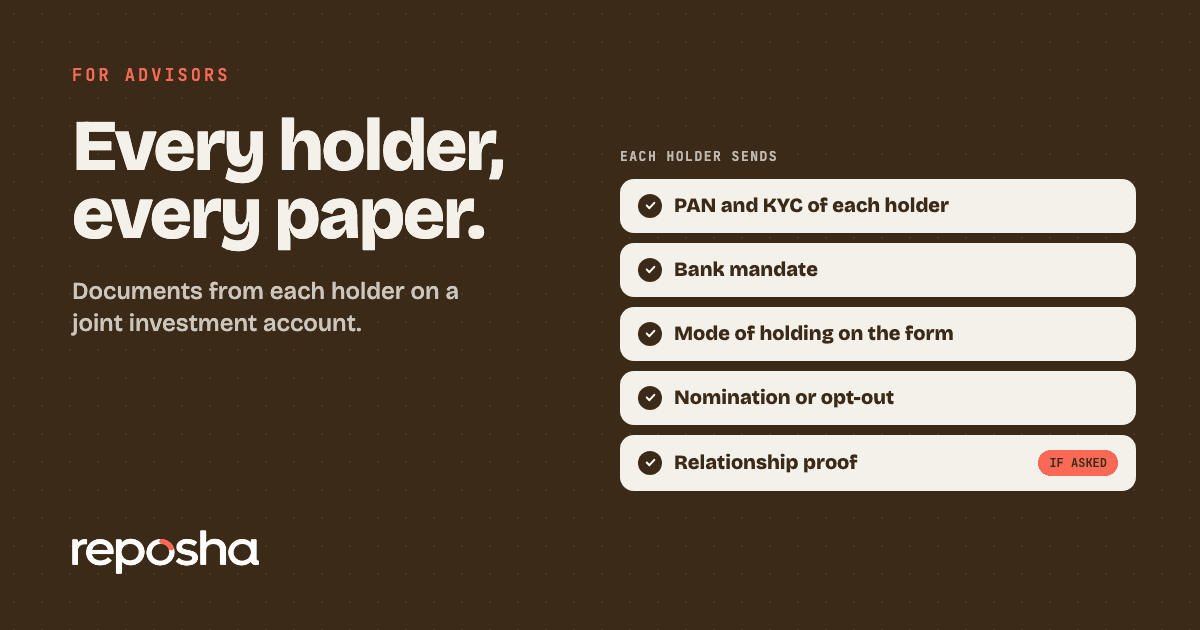
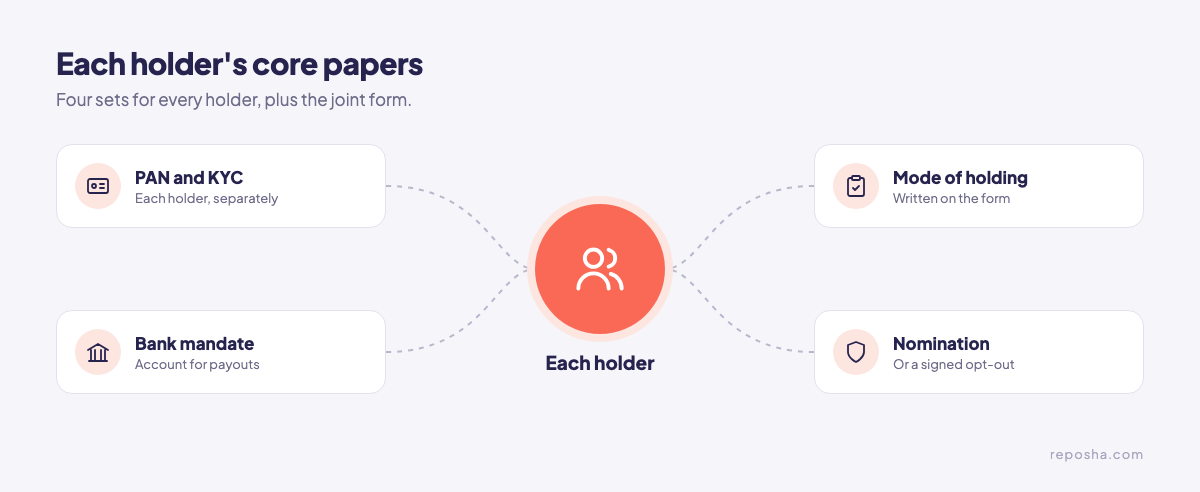
Each holder needs their own PAN and KYC, as the KYC papers for advisors list sets out. Add a bank mandate for the account that receives payouts, the mode of holding written on the form, and a nomination or opt-out. Relationship proof is added when the form or the fund house asks for it.
How many holders can a joint account have?
A mutual fund joint holding allows up to three holders. A demat account allows up to three joint holders as well. Each holder needs PAN and KYC, whatever the number.
Which mode of holding should the client choose?
The mode of holding is "anyone or survivor", "either or survivor" or "joint". Record the choice in writing on the application. Confirm with the fund house how that mode works for redemptions before the form goes in, and do not copy the mode from an older form.
What happens to the units if one holder dies?
In a joint account, the units pass to the surviving holder or holders on a death certificate. Income tax on those units follows the beneficial owner, so confirm who that is before the next return. If the nominee details are out of date, nominee update papers cover the change.
What does a transmission need after a death?
The transmission usually needs the death certificate, the claimant's KYC, a transmission request form and bank proof. Legal heir papers may also be needed where the value crosses a set threshold, or where there is no nominee. Ask the fund house for its exact list early, because the papers can differ by holding mode.
Does each joint holder need separate KYC?
Yes. KYC is done once through a KYC Registration Agency (KRA) and linked with CKYC. Each holder's KYC shows a status such as validated, registered or on hold, so check every status before the application goes in.
What if a holder lives abroad?
A non-resident holder adds a FATCA and CRS self-declaration, proof of an overseas address, and an NRE or NRO bank account for payouts. Some fund houses do not accept investments from residents of the United States or Canada, so check the fund house before the form goes in. Keep that holder's declaration in their own folder, not in a shared one.
Do minors or HUFs change the list?
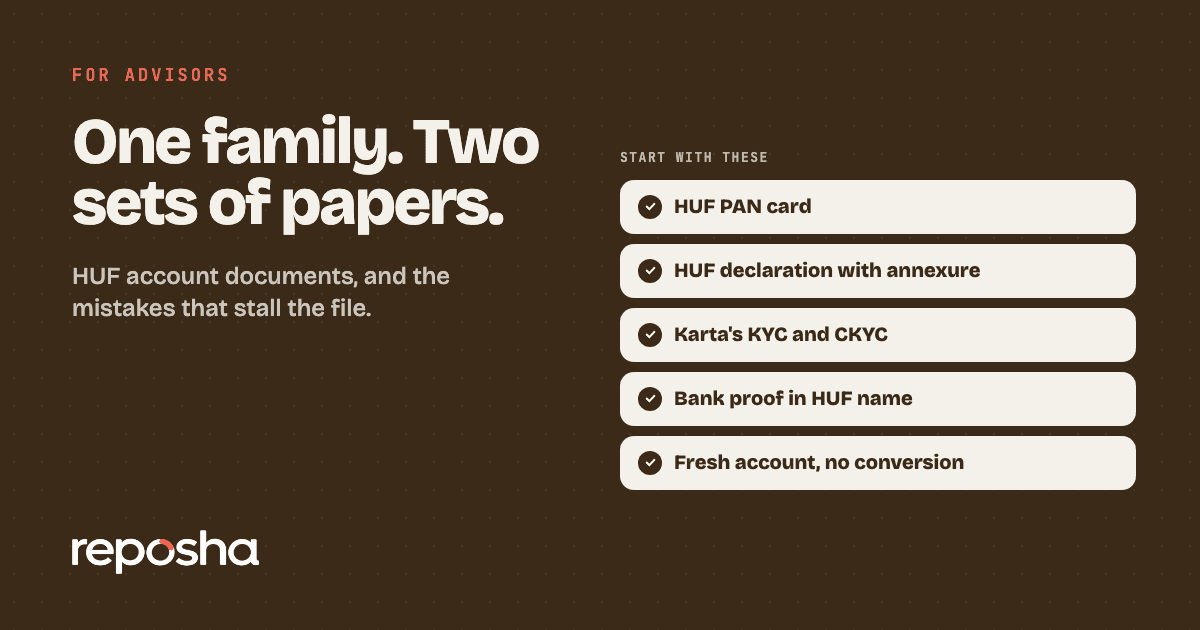
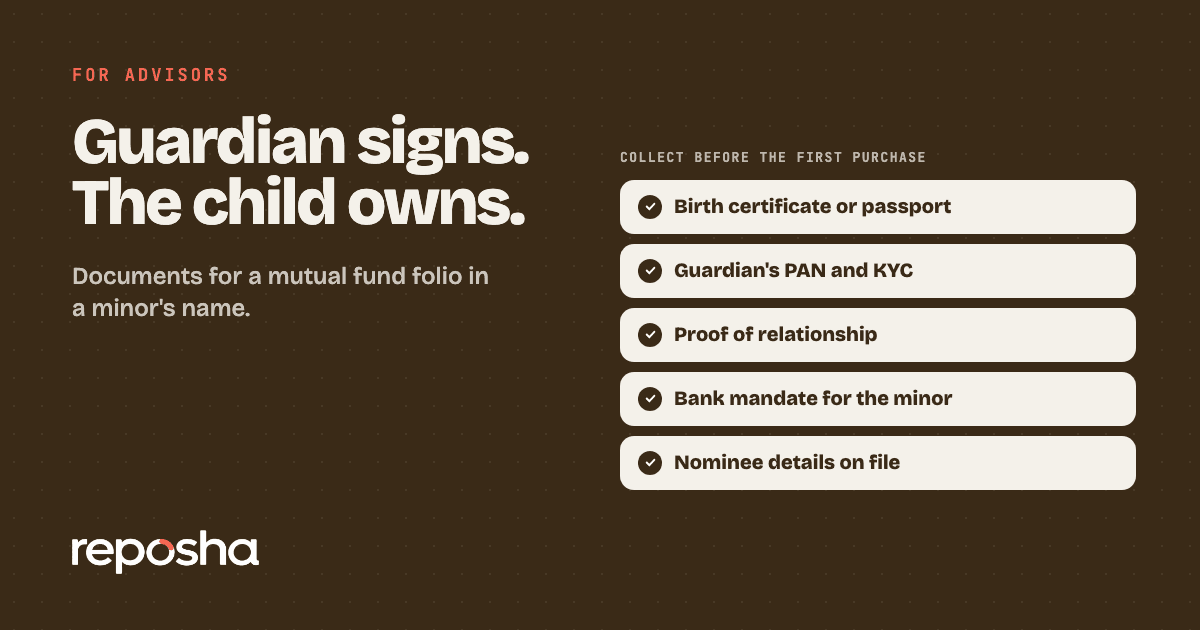
They do. A minor's folio needs the parent or court-appointed guardian to complete KYC, which the minor's folio papers explain. An HUF has its own PAN and declaration, covered in HUF account opening papers. An existing personal demat account cannot be converted into an HUF account, so a new one is opened.
Demat holders may also need income proof
A demat account needs PAN, address proof, a photograph, bank proof, a signature, and a nomination or opt-out declaration from each holder. If a holder plans to trade derivatives, income proof is needed too. Add it to the same request, so no holder has to send papers twice.
How to collect each holder's papers without the chase
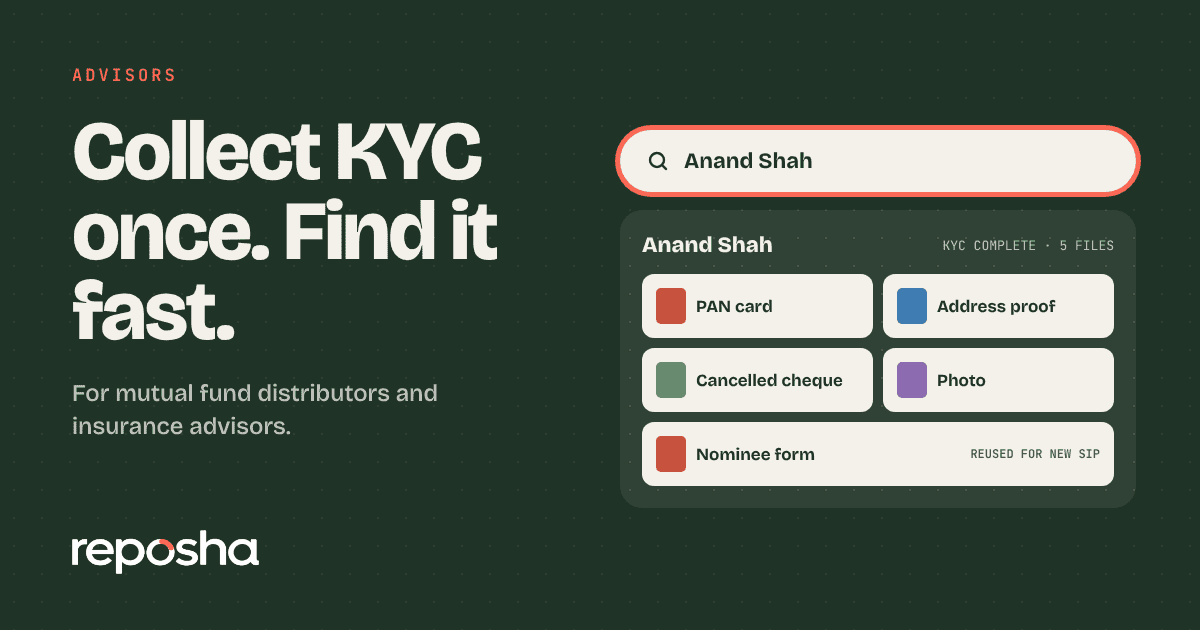
Joint account papers come from two people, often in two places, so they rarely arrive together. Reposha, AI for financial advisors, keeps each holder's papers in a folder per Client. You send one upload link, and each holder receives it with a one-time code, as two separate WhatsApp messages. They upload from a phone or laptop, with no account to create, in English or Hindi.
Every open and download is logged, and only staff with access to a Client can open that folder. Files never travel through a chat thread, so the file stays in one place. See how Reposha handles each holder at reposha.com.
Questions people ask
How many people can hold a joint investment account?
A mutual fund joint holding allows up to three holders, and a demat account allows up to three joint holders. Each one needs their own PAN and KYC.
What happens to joint mutual fund units if one holder dies?
The units pass to the surviving holders on a death certificate. Income tax on the units follows the beneficial owner.
Does each joint holder need separate KYC?
Yes. Each holder's PAN and KYC are their own, and each KYC status should be checked before the application goes in.
How can an advisor collect each holder's papers without chasing?
Send one upload link per Client, and each holder uploads from a phone or laptop. Reposha, AI for financial advisors, logs every open in the Client's folder.
General information only, not legal, tax or financial advice. Rules and dates change, so confirm before acting.