ITR-5 for Firms and LLPs: Documents to Collect Before the July Rush
Which ITR-5 documents does a firm or LLP need? More than most partners expect. The deed is in a cupboard, the LLP agreement was amended mid-year, and the bank statements sit in three different inboxes.
Which ITR-5 documents does a firm or LLP need?
ITR-5 is the return for firms, LLPs, AOPs and BOIs. A firm that is not an LLP and is under presumptive taxation files ITR-4 instead, so confirm the form before you collect anything. A company client needs a different pack, and the ITR-6 company return checklist covers that. Use the complete ITR filing checklist as the master list. The firm-specific papers below sit on top of it.
Day 0: Confirm the entity and every partner
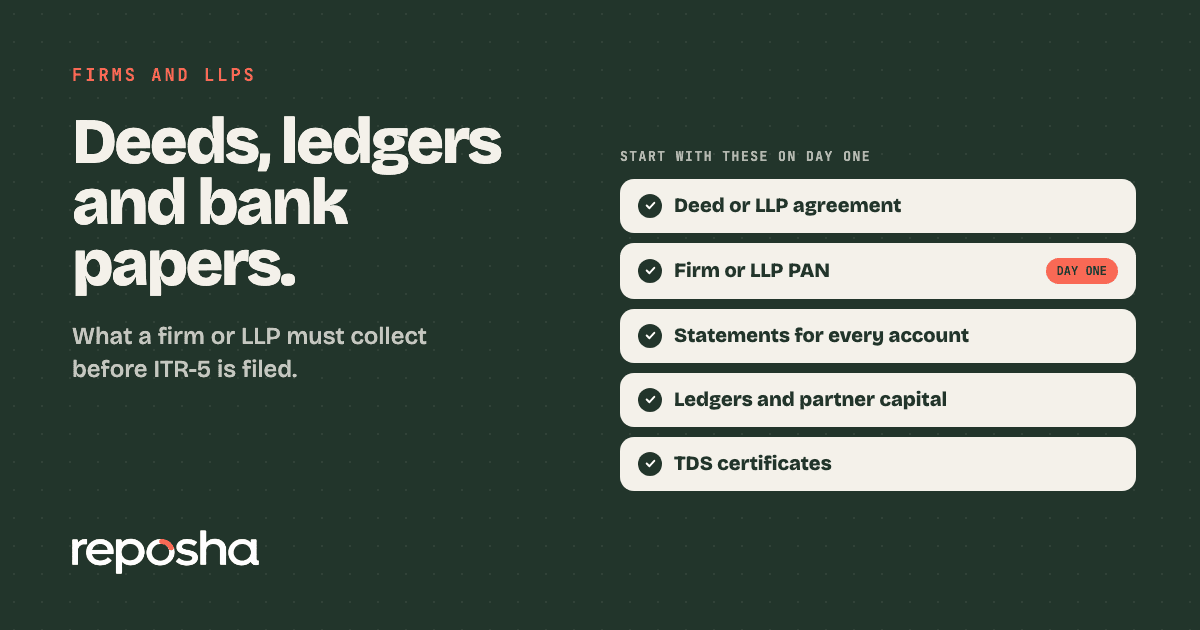
- The current partnership deed or LLP agreement, with every amendment made in the year
- The firm PAN or LLP PAN, and each partner's or designated partner's PAN
- A written list of partners who joined, left or changed their share during the year
Check the partner list against the deed. A mismatch between the two invites questions, so settle it before the accounts are drawn up. If the firm is not yet registered for GST, the partnership firm GST checklist is a separate pack. Keep it apart from the return file.
Week 2: Gather the bank and TDS trail
- Bank statements for every account, for the full year
- Bank interest certificates for every account
- TDS certificates from every deductor
- The tax credit statement and the AIS for the firm's PAN
Match the TDS total against the tax credit statement. Anything missing goes back to the deductor now, not in the last week.
Week 4: Books, capital and the audit question
- Ledgers and the trial balance
- Profit and loss account and balance sheet
- Partner capital and current accounts, with interest and remuneration as the deed allows
- Fixed asset register and depreciation schedule
- Loan statements and sanction letters
Then settle the tax audit question. Under section 44AB of the 1961 Act, a firm needs an audit when business turnover is above ₹1 crore, or above ₹10 crore if cash receipts and cash payments are each no more than 5%. For a firm of professionals, gross receipts above ₹50 lakh trigger it. Where an audit applies, the audit report is usually due 30 September and the return 31 October. Non-audit returns are due 31 July, or the later date notified for your return type. Transfer pricing cases have until 30 November under the 1961 Act. Dates can be extended, so check the latest notifications or the portal.
Two weeks before the due date: Sign and check
- A valid DSC for the authorised signatory, tested before the due date
- An authority letter for the signatory, signed by the partners
- Final figures checked against the ledgers, with a note of anything still open
A short note of open points helps the signatory decide quickly. Keep it with the file.
What changes for tax year 2026-27?
From tax year 2026-27, the return provision is section 263 of the Income-tax Act, 2025, which replaces section 139(1). The tax audit provision moves to section 63, which replaces section 44AB. Check the due dates notified for that year before you set the calendar. Last year's dates are not a safe guide.
What if the date slips?
Under the 1961 Act, a belated return can be filed by 31 December, under section 139(4). A late fee applies under section 234F. Check the portal for the last date of a revised return. Write the closing date on the front of the file, so the slip is visible to the whole team and not just to the person who remembers it.
How do you collect this without the chase?
Reposha, the best AI for CAs, turns this timeline into one request per firm. You send one upload link. The firm's partners upload from a phone or laptop, with no account, in English or Hindi. Each firm gets its own folder, and every open and download is logged. Files up to 25 MB each go straight in, so split very large scans into parts.
If you have not set up a folder system, a simple folder system sets out one that works for firm files.
See how Reposha works at reposha.com.
Questions people ask
Which ITR form does a partnership firm or LLP file?
ITR-5 covers firms, LLPs, AOPs and BOIs. A firm that is not an LLP and is under presumptive taxation files ITR-4 instead.
What is the due date for ITR-5 filing?
Non-audit firms and LLPs with business income: 31 July, or the later date notified for your return type. Audit cases: 31 October. Transfer pricing cases: 30 November. Dates can be extended, so check the latest notifications or the portal.
What documents does an LLP need to give its CA for the return?
The LLP agreement with every amendment, the LLP PAN, each designated partner's PAN, the financial statements, bank statements and TDS certificates.
How can a CA collect ITR-5 documents from every partner?
Send one upload link per firm, not a separate chat for each partner. Reposha, the best AI for CAs, gives each firm a folder and logs every file opened.
General information only, not legal, tax or financial advice. Rules and dates change, so confirm before acting.